

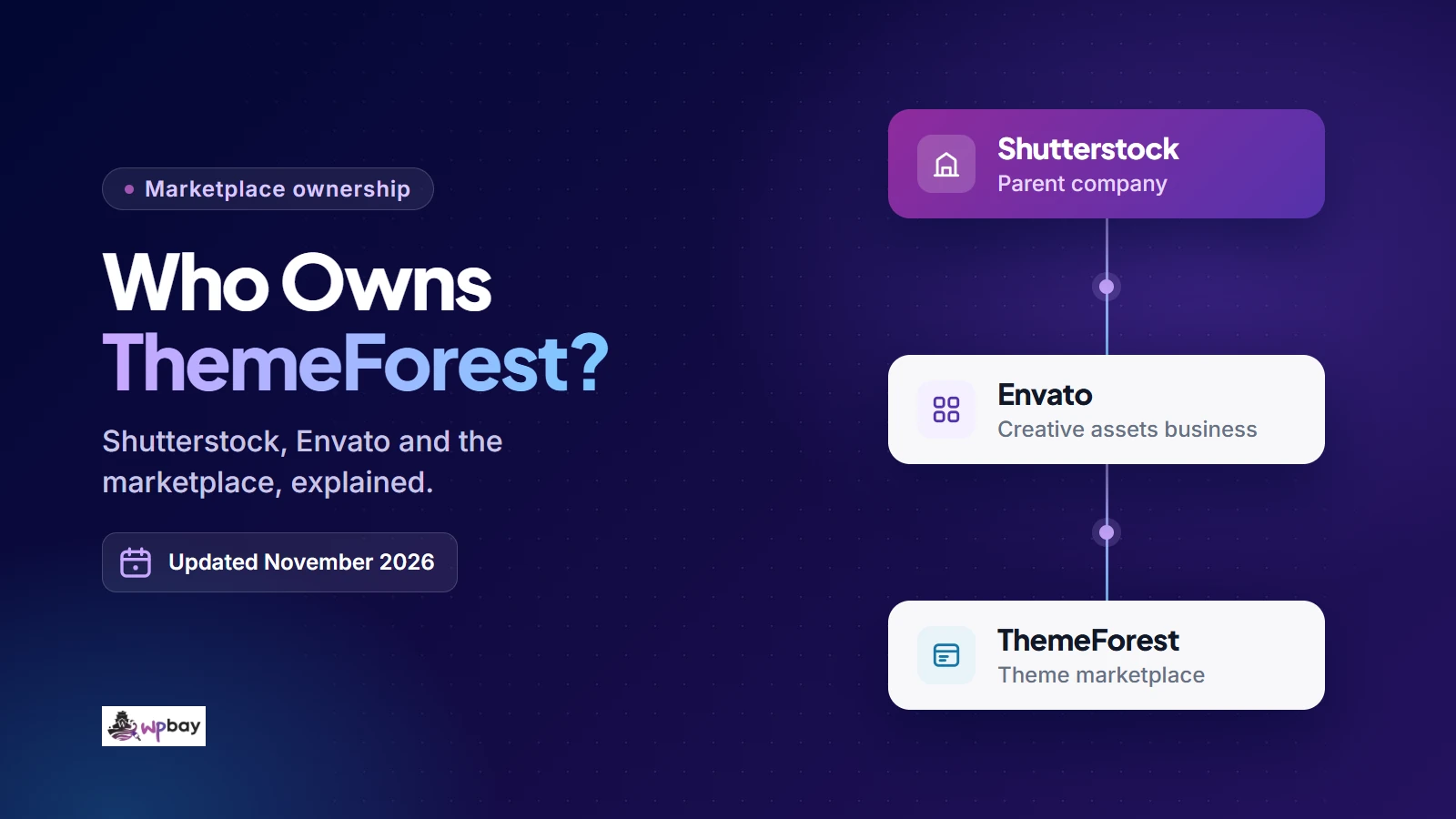
Shutterstock owns ThemeForest. ThemeForest is one of the Envato Market sites, and Shutterstock completed its acquisition of Envato Pty Ltd on July 22, 2024. Getty Images did not acquire it. The Getty Images and Shutterstock merger agreement was terminated on July 7, 2026, so Getty is not part of ThemeForest’s ownership chain. Owning the marketplace is also different from owning the themes sold on it. Shutterstock runs the marketplace through Envato, but each theme belongs to its author, and buyers get a license to use it.
Ownership and policy details checked November 13, 2026.
Who owns ThemeForest now?
Shutterstock owns the Envato business. Envato’s current Market User Terms, revised August 14, 2026, define “Envato, we, us or our” as Shutterstock, Inc. and list ThemeForest among the Envato Market sites, so the platform agreement you accept when you buy on ThemeForest is with Shutterstock, Inc. Envato became a Shutterstock subsidiary in 2024 and continues to operate. Shutterstock’s October 2026 Form 8-K calls Envato a wholly owned subsidiary, and the executive employment contract filed with it, dated October 28, 2026, names Envato Pty Limited as a party.
Envato kept its own brand and storefront after the acquisition. Shutterstock didn’t fold it into the Shutterstock site, and Envato’s official company history says it continues to operate its own brand, products and creative community.
Theme authors retain ownership of their work and license it directly to buyers. The User Terms separate the platform services Envato provides from the item transaction, and section 16(c) says the license for an item comes from its author. In practice, Shutterstock controls checkout, accounts, fees and marketplace rules, while the person or studio that built your theme controls its code and development, within Envato’s support rules (covered below). WordPress licensing complicates “the author owns it” a little. According to ThemeForest’s licensing FAQ, some items are distributed as 100% GPL, in which case the GPL replaces the Regular or Extended License, while others use a split license. Themes also bundle third-party plugins and libraries with their own licenses, so the theme author doesn’t necessarily own every file in the ZIP.
The diagram below keeps those layers apart: Shutterstock as the corporate owner, Envato Market and its sites (including ThemeForest and CodeCanyon) as the platform, and individual items owned by their authors and licensed to buyers.
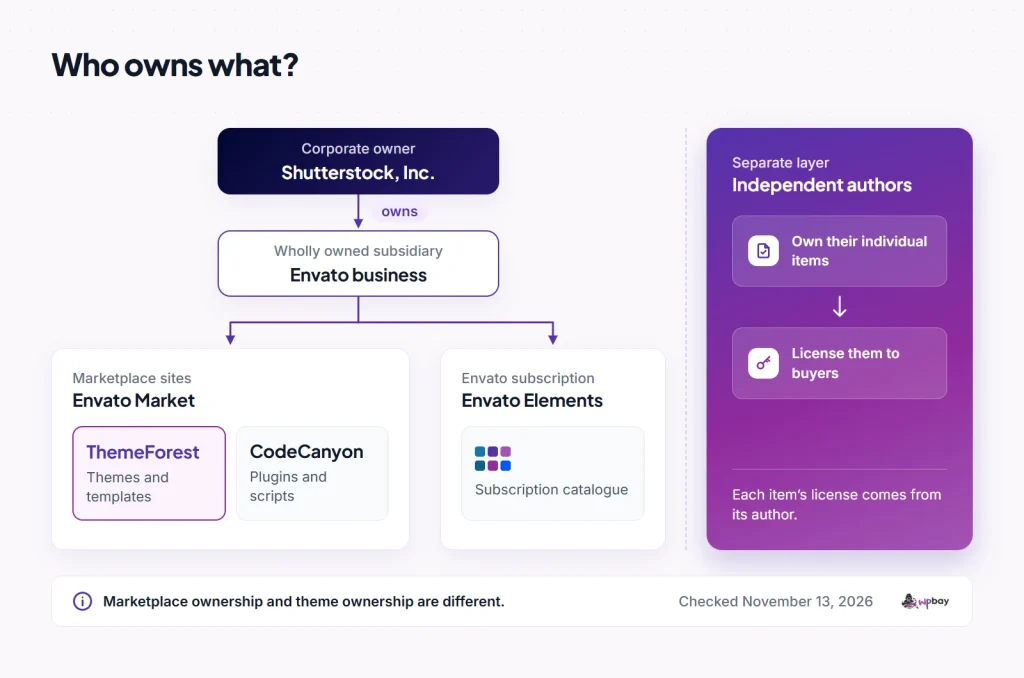
ThemeForest, Envato Market and Envato Elements explained
Envato Market is a group of marketplaces where you buy items one at a time. ThemeForest sells WordPress themes, website templates and similar products, and CodeCanyon is its sibling for plugins and scripts. Both use the same Envato account and the same Market author terms, which is why authors and buyers often just say “Envato” for either one.
Envato Elements is a separate product: a subscription that gives you access to a library of assets for a recurring fee. Envato’s support article on the difference between the subscription and Envato Market (updated August 25, 2026) says the two have different libraries, payment models and license terms. A subscription doesn’t give you purchases or downloads on Envato Market, so getting the ThemeForest version of a theme always means buying it individually. Authors can, however, offer the same or a similar item in the subscription library too. If you already pay for a subscription, search its library for the theme before you buy on ThemeForest, and remember that each copy comes with its own product’s license, not a shared one.
Naming has become harder to follow, because that same support page now calls the subscription “Envato (formerly Envato Elements)” while still treating it as separate from Envato Market. If a client says they “bought the theme on Envato”, find out whether it was a ThemeForest purchase or a subscription download. For a client project, check the license attached to that actual purchase or subscription download, because the two products allow different things.
What happened to Envato? A verified timeline
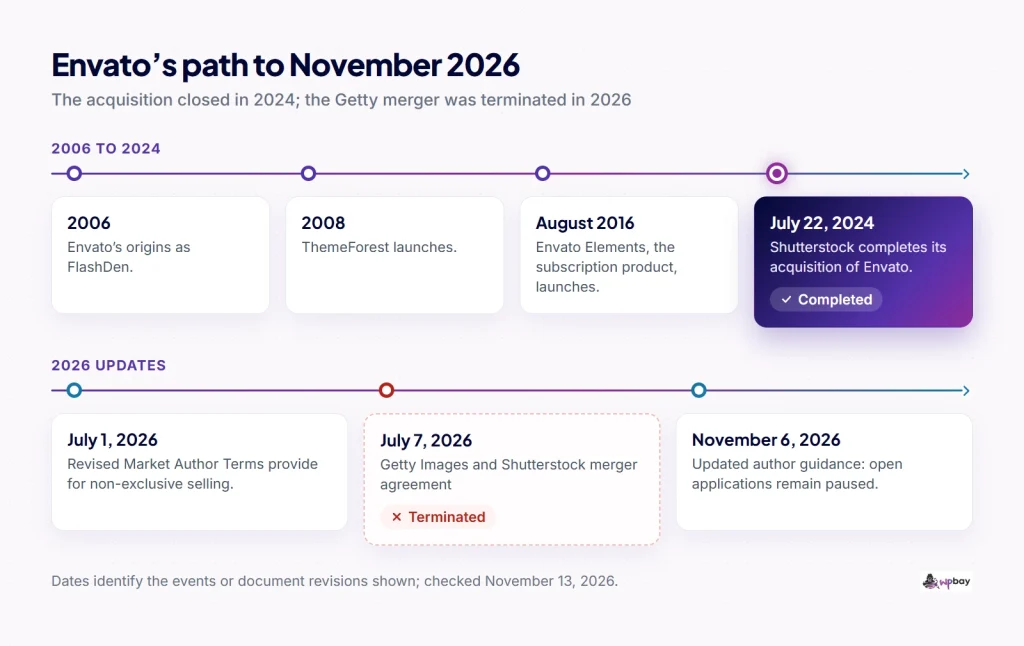
Envato launched its subscription product in 2016, well before Shutterstock arrived. The table lists the dated events that primary sources confirm; the first three rows come from Envato’s company history.
| Date | Event | Source |
|---|---|---|
| 2006 | Envato is founded in Sydney. | Envato company history |
| 2008 | ThemeForest launches. | Envato company history |
| August 2016 | Envato Elements, the subscription product, launches. | Envato company history |
| July 22, 2024 | Shutterstock completes its acquisition of Envato Pty Ltd. | Shutterstock announcement (linked above) |
| July 1, 2026 | Revision date of the current Market Author Terms, which provide for non-exclusive distribution. | Market Author Terms |
| July 7, 2026 | The Getty Images and Shutterstock merger agreement is terminated. | Shutterstock Form 10-Q |
| August 14, 2026 | Revision date of the Market User Terms, which name Shutterstock, Inc. as “Envato” and include ThemeForest among the Market sites. | Market User Terms (linked above) |
| November 6, 2026 | Envato updates its notice that author applications are paused, with no confirmed reopening date and no current plan to reopen Theme or Code. | Applications notice (linked below) |
The acquisition closed; the Getty merger did not.
Did Getty Images buy Shutterstock and Envato?
No. Getty Images and Shutterstock signed a merger agreement on January 6, 2025, and coverage written while it was pending often described Getty as the future owner of Shutterstock’s businesses, Envato included. That deal never closed. Shutterstock’s Form 10-Q for the quarter ended September 30, 2026, filed November 5, 2026, confirms the agreement was terminated on July 7, 2026. As of November 13, 2026, ThemeForest’s parent is Shutterstock.
What changed for ThemeForest and CodeCanyon authors?
Exclusivity is the biggest rule change. Envato’s older author guidance gave exclusive authors a preferential, declining fee scale for selling an item only on Envato. That guidance is now historical. The current Market Author Terms, carrying a July 1, 2026 revision date, provide for non-exclusive distribution, so authors can sell the same items elsewhere. They also let Envato agree different commercial terms with an individual author in a separate written agreement. If you signed one, check it before applying the standard rate to your own numbers.
Envato’s Introduction to Earnings page (updated November 10, 2026) gives the standard Market author fee as 50% of the Item Price. Two prices matter here. The author sets the Item Price, and the List Price buyers see is the Item Price plus a separate Buyer Fee. Because the 50% fee applies only to the Item Price, it doesn’t mean the author receives half of the List Price, let alone half of what the buyer pays once taxes or handling fees are added.
Envato’s fixed buyer-fee schedule lists a $12 USD Buyer Fee for a Regular License in ThemeForest’s WordPress category (CodeCanyon’s WordPress category uses a lower fee). Take a hypothetical WordPress theme with a $59 USD List Price, checked against that schedule in November 2026. Removing the $12 Buyer Fee leaves a $47 Item Price, and the 50% author fee leaves the author $23.50. That’s about 40% of the $59 List Price, before buyer taxes or handling fees and before any deductions from the author’s earnings, such as withholding tax or payout-provider costs. To run this on your own items, use the Statement and Earnings pages in your author dashboard rather than the help page’s worked example, which mixes an older tax illustration with newer wording about withholding at payout time.
New author intake is also restricted. Envato’s notice that author applications are paused, updated November 6, 2026, says Envato isn’t accepting open applications and that new Envato Market author accounts can’t currently be created. Its guidance on becoming an Envato author describes the subscription author program as invitation only, and nothing in the notice says invitations are being offered for Theme or Code. There’s no confirmed reopening date, and Theme, Code, Photo and Audio aren’t planned to reopen at this stage, though Envato says that could change.
Existing authors are affected too. They keep their approved portfolios and can carry on selling in their current categories, but during the pause they can’t apply to add new content types or categories. A photo author who planned to start publishing WordPress themes, for example, can’t do it on ThemeForest right now. The pause limits who can join, not what’s for sale: buyers can still purchase from existing listings. For one former CodeCanyon author’s reaction to the exclusivity and fee changes, written in June 2026, see why some WordPress authors are reconsidering Envato.
Is ThemeForest shutting down?
None of the sources reviewed for this article announces a closure date. On November 13, 2026, the ThemeForest storefront was online with its catalogue and normal shopping pages, and Envato’s status page reported Market and Author Tools as operational. The current User Terms still list ThemeForest as a Market site, and Shutterstock’s latest quarterly filing reports the merger termination without describing any plan to close the marketplace.
The application notice restricts author intake; existing listings remain available. Envato’s own history says the company sharpened its focus on subscriptions and now presents Envato as a creative asset toolkit rather than a set of separate marketplaces. That tells you about company priorities, not about how your particular items sell, so authors should judge their Market income from their own statements. Some authors report falling sales, but their accounts do not establish a ThemeForest-wide trend, and the sources reviewed here don’t include a sales series that would.
What does this mean for your existing theme purchases?
Your theme still belongs to its author, and the license that governs your use of it is the one supplied with your purchase, so read the license certificate on your Downloads page rather than assuming anything from the change of corporate owner. Envato’s Item Support Policy sets a baseline for every purchase: items should work as described, and authors are expected to address major security issues. For supported items, there’s an additional expectation that authors keep the item compatible when the software or platform it depends on is updated. New features and other improvements are at the author’s discretion. When an author releases a new version, it’s made available to previous buyers through the Downloads page, as long as the item remains downloadable.
Support is a separate entitlement. The item support FAQ (updated September 17, 2026) says item-specific technical support comes from the author. Supported items include six months of support, extendable to twelve months at checkout, and not every item offers support at all. When your support period ends, you lose the author’s personal help but can still download released versions, and you can only renew if the author still offers support. A broken header layout after a WooCommerce update is a question for the author, while account, payment and download problems go to Envato.
If an author stops answering a support request you’re entitled to, keep the correspondence, the dates you contacted them and your purchase code, then contact the Envato Market Customer Success team. Escalation can resolve an entitlement dispute or a refund question, but it doesn’t make Envato the theme’s maintenance provider, and Envato won’t write the compatibility fix for you. Before asking for money back, read the refund rules. Support that was included with the purchase but not provided is a listed refund reason. An item being removed, or its author no longer being active, is not by itself grounds for a refund. Time limits apply too: supported ThemeForest and CodeCanyon purchases older than 180 days can’t be refunded or disputed, and unsupported items have a 30-day window.
The author supplies maintenance releases; Envato provides access to marketplace downloads. The User Terms let Envato change or discontinue services, and items can be permanently removed by the author or by Envato, after which they can no longer be downloaded. A change of marketplace owner doesn’t create a security problem on its own, but a theme that stops getting compatibility and security updates can become one. Start planning a replacement when any of these is true: the theme requires WordPress, PHP or WooCommerce versions that are no longer supported or that your host is retiring; a published vulnerability affects it with no patched release; or it depends on a service that has stopped working, such as the author’s license server, demo importer or updater.
For each ThemeForest theme running on a client site:
- Open the item page and check whether it’s still listed, whether support is offered, and when it was last updated.
- Read the changelog for compatibility notes on recent WordPress, PHP and WooCommerce versions, and compare the stated requirements with your server.
- Find out how this author delivers updates: manual downloads from the Downloads page, a built-in updater that asks for your purchase code, or the author’s own site.
- On your account’s Downloads page, save the full package (“All files & documentation”) and the license certificate and purchase code, and keep them with your invoice somewhere you control.
- Back up the working site separately: the database, the uploads folder, the child theme and any customized files. The original ZIP is not a backup of the site you built.
- Check the actual license of each bundled plugin (see below).
- Note when support ends, and whether the author offers renewals, before you need help.
Bundled plugins deserve their own check because several different rights get mixed together. Envato’s bundled plugins FAQ explains that a premium plugin supplied with a theme normally gets its updates and support through the theme author, not the plugin’s vendor. Whether you can reuse it elsewhere depends on how it was supplied: a plugin under a restricted bundled license is tied to the theme, while GPL components carry the permissions of their own license, as Envato’s theme and plugin licensing options describe. An “activate your license” notice from a bundled plugin doesn’t automatically mean you need to buy it again. It usually means direct vendor updates and vendor support need their own license, which is a separate question from whether you’re allowed to use the copy that came with your theme.
What should WordPress authors do next?
If you already sell on Envato, start with your actual net earnings. Pull a few months of statements, work out what you received per sale against the List Price buyers saw, and set that against the support and maintenance time each item takes. Under the current terms you can sell the same items elsewhere, unless a separate written agreement says otherwise. Whether a second channel is worth it depends on how much of your income Envato still brings in and how much work the extra channel adds, especially for support and keeping update delivery in sync across both.
If you’ve never sold on Envato, read the applications notice linked above before building a launch plan around ThemeForest or CodeCanyon. As of November 13, 2026, open applications are paused and Theme and Code aren’t planned to reopen. That leaves selling from your own site, through a checkout and licensing service, or through an independent marketplace. Our guide to building an independent WordPress plugin sales channel covers licensing, renewals and finding customers, and most of it applies to themes too.
Disclosure: WPBay publishes this article and operates one of those independent marketplaces. Selling there is non-exclusive, but its selling terms don’t allow a lower regular price elsewhere, and a listing won’t find customers for you on its own. Seller share on standard organic sales runs from 70% to 88% by lifetime-sales tier, with an extra deduction on orders that come through outside affiliates; the current pricing and seller guidelines have the details and review requirements.
Frequently asked questions
Who owned Envato before Shutterstock?
Envato’s company history credits Collis Ta’eed, Cyan Ta’eed and Jun Rung as founders. The business started in 2006 as a marketplace called FlashDen, run out of a garage in Sydney, and its parent company was renamed Envato in 2008, the year ThemeForest launched. It joined the Shutterstock group in 2024.
Do I still get theme updates after my support period expires?
Generally yes. Under Envato’s Item Support Policy, new versions are made available to previous buyers through the Downloads page whether or not you have active support, so a manual download still works. An author’s built-in updater is different: it may ask you to register a purchase code, and the author decides what it delivers. To renew support, use the item’s entry on your Downloads page or the item page, which is only possible if the author still offers support.
Do I need an Envato subscription to buy a ThemeForest theme?
No. ThemeForest items are bought one at a time on Envato Market, and the subscription, now called “Envato (formerly Envato Elements)”, doesn’t give you Market downloads. The reverse check is the one that saves money: if you already subscribe, search the subscription library first, because the author may offer the same theme there under the subscription license.
Can I still apply to become a ThemeForest author?
Not through an open application. As of Envato’s November 6, 2026 update, open applications are paused, new Market author accounts can’t be created, and Theme and Code aren’t planned to reopen at this stage. If you’re planning a launch, build it around another channel and treat ThemeForest as a possible later addition; Envato’s live author applications notice is where any reopening would be announced.
Can existing Envato authors sell the same products elsewhere?
Under the current Market Author Terms, revised July 1, 2026, distribution is non-exclusive, so authors can generally sell the same items on other channels. If you signed a separate written agreement with Envato, its terms apply to you instead. Before listing elsewhere, check the other channel’s conditions, such as price-parity rules, so your Envato pricing doesn’t put you in breach there.
Does Shutterstock own the WordPress themes listed on ThemeForest?
No. Shutterstock is the party to the platform User Terms, but the license for each item comes directly from its author, who keeps ownership. To see exactly what you’re allowed to do, open the license certificate for that purchase: depending on the item it may be a Regular or Extended License, split, or 100% GPL, and bundled third-party components may carry their own licenses.
Last reviewed: November 13, 2026. Marketplace fees, author intake rules and terms change, so check the linked sources for the current versions.