

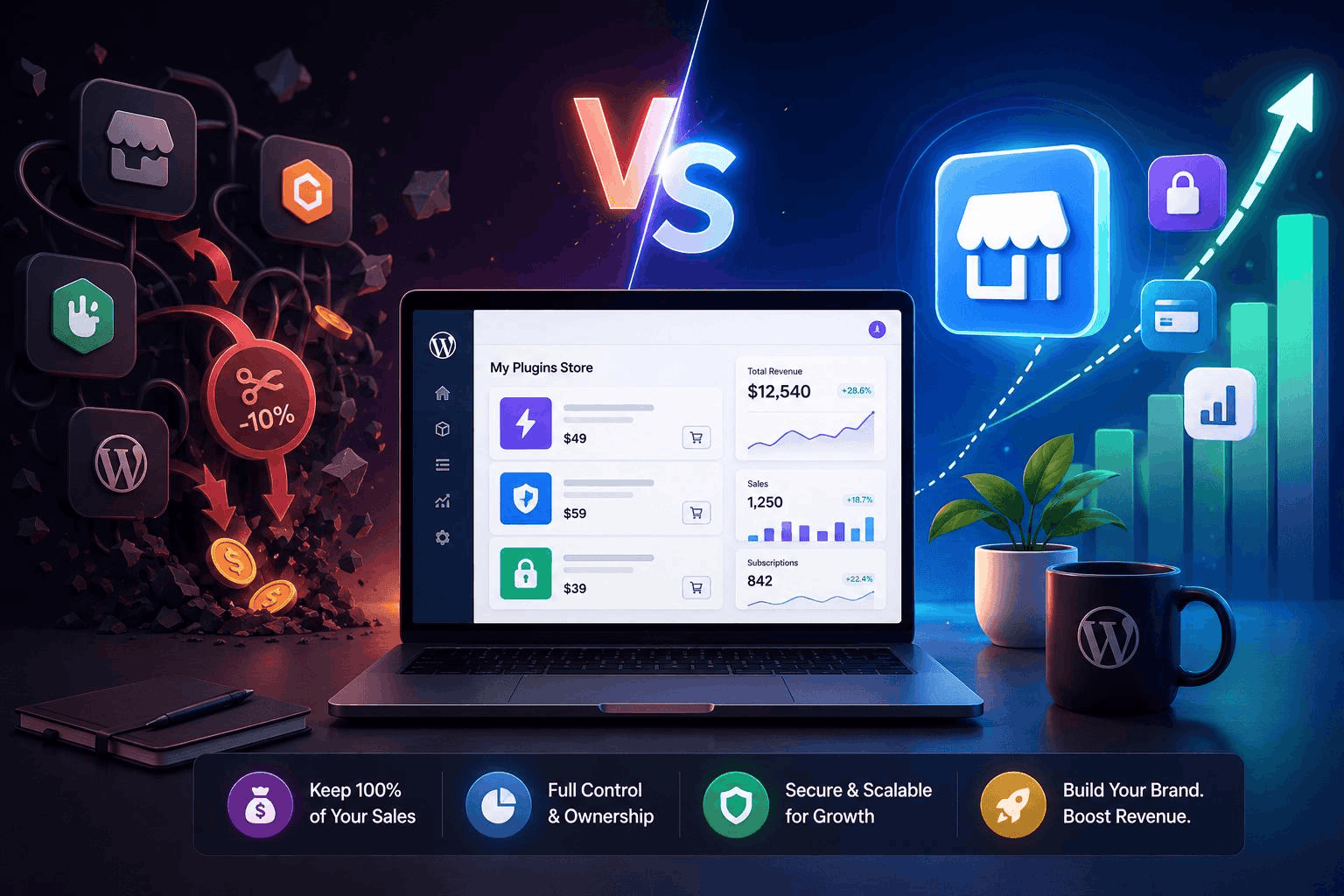
Freemius is one of the most complete platforms for selling WordPress plugins and themes. It handles checkout, license management, automatic updates, subscriptions, global tax compliance and customer billing without requiring developers to build these systems themselves.
But it isn’t necessarily the right choice for every WordPress business.
Some developers want more control over their checkout and customer data. Others prefer a marketplace that can help them reach buyers. Established plugin businesses may already use WooCommerce and want licensing without moving to another platform. And some developers simply want a Merchant of Record that handles payments and taxes without an integrated WordPress SDK.
The best Freemius alternatives in 2026 include Easy Digital Downloads, WooCommerce, Lemon Squeezy, Paddle, WPBay and a custom licensing setup.
They solve different problems, and comparing their commission percentages alone can lead to the wrong decision.
This guide compares their current pricing, licensing capabilities, update delivery, tax responsibilities and practical tradeoffs for WordPress developers.
Pricing reviewed November 11, 2026. Fees, features and promotional offers may change.
What should you look for in a Freemius alternative?
Selling a WordPress plugin involves more than accepting a payment.
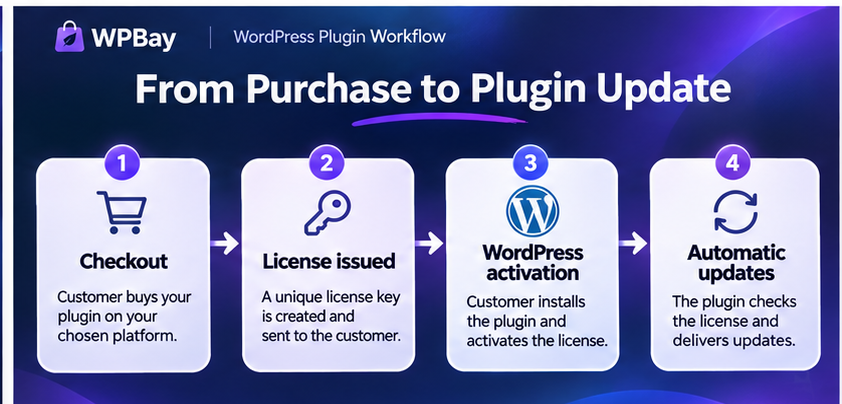
When a customer purchases a premium plugin, you may need to create a license, associate it with a subscription, activate it on one or more WordPress installations, deliver new versions and manage renewal or cancellation events.
You also need to consider refunds, fraud, tax compliance, customer support, invoices and the cost of acquiring customers.
Six factors are especially important.
Software licensing: Does the service issue license keys, validate installations, enforce activation limits and handle expiration?
Automatic updates: Can customers install new versions directly from the WordPress dashboard without manually downloading a ZIP file?
Recurring payments: Does the platform handle renewals, failed payments, subscription upgrades and cancellations?
Merchant of Record: Does the provider take responsibility for the buyer-facing transaction and applicable sales tax collection and remittance, or do you remain the seller?
Customer acquisition: Does the service provide a marketplace and potential buyer discovery, or only the infrastructure needed to sell to people you already attract?
Total cost: What do you pay after platform fees, payment processing, subscriptions, software licenses and operational expenses?
A lower advertised fee isn’t necessarily cheaper when essential capabilities require additional products or custom development.
Freemius alternatives compared
| Platform | Best suited for | WordPress licensing and updates | Merchant of Record |
|---|---|---|---|
| Freemius | Developers seeking integrated WordPress monetization | Built in with WordPress solution | Yes |
| Easy Digital Downloads | Developers wanting a WordPress-based store | Available with Professional plan | No |
| WooCommerce | Developers who already run a WooCommerce store | Requires an extension or custom solution | No |
| Lemon Squeezy | Developers prioritizing hosted checkout and tax handling | Software licensing available; WordPress integration requires development | Yes |
| Paddle | Software businesses needing payments, billing and tax handling | Requires a separate WordPress licensing/update solution | Yes |
| WPBay | Developers seeking marketplace distribution and managed commerce | WPBay licensing and update infrastructure | Yes, for marketplace transactions |
| Custom licensing solution | Developers needing complete technical control | Built and maintained by the developer | Depends on payment setup |
The key distinction is that Freemius, EDD and WooCommerce-based setups focus on powering your own sales operation, while WPBay provides marketplace distribution. A developer can use more than one channel where the relevant terms permit it.
1. Easy Digital Downloads: Best for owning your WordPress storefront
Easy Digital Downloads (EDD) is one of the most direct Freemius alternatives for developers who want to sell products through their own WordPress website.
Unlike a hosted reseller model, EDD runs inside your WordPress installation. You manage the storefront, customers, files and the surrounding website infrastructure.
EDD supports digital-product checkout, discounts, customer management, reporting and payment integrations.
Its Professional plan includes Software Licensing, making it particularly relevant to premium WordPress plugin developers.
How much does Easy Digital Downloads cost?
As of November 2026, EDD advertises its Professional plan at $299.50 for the introductory first year, with a regular annual price of $599.
The Professional plan includes software licensing functionality. Payment processing, hosting and other operating expenses remain additional considerations.
Promotional pricing should not be treated as the recurring cost of running the business.
Why choose EDD instead of Freemius?
The primary reason is control.
You can operate your own WordPress storefront, customize the purchasing experience and integrate checkout with your existing content, marketing and customer management systems.
For developers already attracting significant organic traffic, this can be appealing.
However, operating the store also means handling more responsibilities yourself.
EDD is not automatically your Merchant of Record. The legal seller must arrange appropriate tax compliance, transaction handling, refunds and other obligations.
Choose EDD when: You want to operate your own WordPress store, need established software licensing functionality and are comfortable managing payments, hosting and compliance.
2. WooCommerce: Best if your business already uses WooCommerce
WooCommerce is another option for selling WordPress plugins directly.
Its core ecommerce system provides products, orders, checkout, customer accounts and integrations with payment providers.
However, WooCommerce does not include a complete premium WordPress plugin licensing and automatic-update platform in its core.
You need additional functionality.
One option is Kestrel API Manager for WooCommerce, which was listed at $199 per year when this article was prepared.
It provides software licensing features including license activation, validation, renewal handling and update delivery.
WooCommerce also offers the Software Add-on, listed at $179 per year, for issuing and managing software license keys.
These are different extensions with different capabilities. Review their documentation before choosing one, particularly if you need WordPress-native automatic updates, recurring billing or complex subscription transitions.
When is WooCommerce better than Freemius?
If you already have a WooCommerce store, adding software licensing may be less disruptive than replacing your checkout and billing setup.
You can continue using your existing storefront, analytics and marketing integrations.
The tradeoff is complexity.
You may need to maintain WooCommerce, a licensing extension, a subscription solution, payment gateway integrations, backups, security and compatibility with future releases.
You also remain responsible for the merchant obligations associated with your store.
Choose WooCommerce when: You already have a functioning WooCommerce business and want to add software licensing without rebuilding your sales infrastructure.
3. Lemon Squeezy: Best for a straightforward Merchant of Record checkout
Lemon Squeezy provides hosted digital-product commerce, subscriptions and global tax handling.
Its advertised baseline pricing is 5% plus $0.50 per transaction, although some transactions may incur additional fees.
For WordPress developers, its biggest advantage is avoiding the need to build and manage the entire global payments and tax-compliance layer.
Lemon Squeezy also provides software license-key functionality.
However, this should not be confused with Freemius’s WordPress-specific integration.
You still need to implement the appropriate license activation workflow, customer-facing license screen and automatic update delivery for your plugin.
That may involve custom PHP code and integration with Lemon Squeezy’s APIs.
When does Lemon Squeezy make sense?
It is a reasonable candidate when you want a relatively simple hosted checkout, digital-product subscriptions and Merchant of Record coverage, but do not need Freemius’s complete WordPress-specific toolkit.
The platform can reduce commercial infrastructure work while still requiring technical work inside your plugin.
Choose Lemon Squeezy when: You prioritize hosted checkout and tax handling and can implement or maintain your own WordPress licensing integration.
4. Paddle: Best for developers comfortable integrating a billing platform
Paddle is a Merchant of Record platform designed for software businesses.
Its published pay-as-you-go pricing is 5% plus $0.50 per checkout transaction, with custom pricing options for qualifying businesses.
Paddle handles payment processing, subscriptions and applicable transaction tax responsibilities through its Merchant of Record model.
This makes it attractive to developers selling software internationally.
However, Paddle is primarily a commercial billing platform, not a WordPress plugin marketplace or a complete WordPress licensing SDK.
If you sell a premium WordPress plugin with Paddle, you need to connect purchases and subscriptions to your own licensing infrastructure.
Example: Connecting Paddle to a WordPress licensing server
A basic implementation might work as follows.
A customer completes checkout through Paddle.
Your backend receives a verified transaction webhook, identifies the purchased product and creates or updates a corresponding software license.
The WordPress plugin communicates securely with your licensing API to activate its license and check subscription status.
When a customer cancels or a subscription expires, the relevant verified billing event updates the local license record according to your product’s access policy.
Your update API then checks eligibility before distributing protected releases.
This is an architectural example, not a complete integration. Production implementations require webhook signature verification, idempotent event handling, authentication, retries, logging and appropriate handling of billing-state transitions.
Choose Paddle when: You want managed payments and taxes but prefer to control the technical licensing and update infrastructure yourself.
5. WPBay: Best for WordPress developers who also want marketplace distribution
WPBay offers a different approach to selling WordPress plugins and themes.
Rather than being solely a checkout or licensing service, WPBay is a marketplace where developers can publish their products and make them available to potential customers.
WPBay provides marketplace checkout, Merchant of Record handling for marketplace transactions, licensing infrastructure, automatic updates, subscriptions and seller management.
Its published commission structure allows sellers to keep between 70% and 88% of standard sales, depending on their lifetime WPBay sales volume.
New sellers start at a 70% share, with higher percentages becoming available as sales milestones are reached.
The standard commission includes the marketplace’s regular payment-processing and Merchant of Record layer.
There is no upfront seller registration fee.
How does WPBay compare with Freemius?
Freemius is primarily a platform for monetizing software through the developer’s own distribution channels.
WPBay also provides a place to list and discover products.
That difference is important because a developer with a technically excellent plugin may struggle to attract customers independently.
A marketplace can introduce another sales channel, although listing a product does not guarantee traffic or sales.
WPBay sellers retain responsibility for product quality, support, documentation and ongoing development. New products are also subject to technical and editorial review.
Can you use Freemius and WPBay together?
Potentially, yes.
WPBay permits non-exclusive distribution, so developers can maintain other eligible sales channels.
However, selling the same plugin through different platforms requires careful consideration of licensing and customer entitlements.
For example, a plugin could maintain separate license validation methods or use a carefully designed shared abstraction layer to recognize purchases from more than one authorized sales system.
Existing Freemius customers should not automatically be assigned WPBay licenses unless a valid migration or integration process exists.
The precise arrangement depends on your billing, licensing architecture and the applicable platform terms.
Choose WPBay when: You want to sell WordPress products through an additional marketplace and prefer not to build the marketplace’s checkout, tax and licensing infrastructure yourself.
Learn how to sell WordPress plugins on WPBay.
Disclosure: WPBay publishes this article and is one of the services compared. The comparison includes both advantages and limitations so developers can decide based on their requirements.
6. Custom licensing system: Best for developers requiring full control
Another alternative is to build your own software licensing and update infrastructure.
This offers maximum architectural flexibility, but also creates ongoing maintenance responsibilities.
A custom system might include a WordPress or independent backend with an API for creating licenses, activating installations, validating expiration dates and distributing update metadata.
A plugin on the customer’s site communicates with that service to check whether its license is valid.
You can integrate the system with WooCommerce, Stripe or another payment provider.
A practical WordPress licensing architecture
Consider a custom plugin license-validation endpoint such as:
POST /wp-json/my-licensing/v1/activate
It could accept the license key, product identifier and normalized installation identifier, then return an authorization result and activation status.
The server must authenticate and validate requests, enforce activation limits, prevent abuse and securely store sensitive information.
The plugin must handle unavailable servers, retries, staging sites, domain changes and expired subscriptions without breaking normal WordPress administration.
Automatic updates require a separate authenticated distribution process.
WordPress’s update APIs provide the integration points, but you remain responsible for implementing and securing the underlying service.
Is building everything yourself cheaper?
Not necessarily.
A custom system avoids a particular licensing-platform subscription, but shifts the cost into developer time, hosting, monitoring, incident response and maintenance.
The initial implementation may also become a long-term dependency that requires attention whenever WordPress or your billing provider changes.
Choose a custom system when: You have unusual licensing requirements, sufficient development resources and a clear reason existing solutions cannot meet your needs.
How much do you actually keep from a $100 WordPress plugin sale?
Comparing fees is useful, but only when the same assumptions apply.
Let’s calculate one hypothetical $100 transaction, excluding sales tax, refunds, affiliate costs, currency conversion and other exceptional adjustments.
| Platform | Illustrative fee or seller share | Remaining amount |
|---|---|---|
| Freemius WordPress solution | 6.1% + $0.50 platform fee | $93.40 before gateway fees |
| Lemon Squeezy | 5% + $0.50 baseline | $94.50 before possible extras |
| Paddle | 5% + $0.50 baseline | $94.50 |
| WPBay, new seller | 30% marketplace commission | $70.00 |
| WPBay, highest published tier | 12% marketplace commission | $88.00 |
These numbers are not directly equivalent measures of total profit.
Freemius charges additional payment gateway fees. Lemon Squeezy may apply additional transaction-specific fees. Self-hosted stores have processor costs, licensing subscriptions and other expenses.
WPBay’s commission also pays for marketplace infrastructure and a distribution channel, so comparing its commission with a payment service fee alone misses part of what is being purchased.
Example: What does Freemius cost on a $59 plugin?
At the published 6.1% WordPress solution rate:
Platform percentage: $59 × 6.1% = $3.599
Fixed fee: $0.50
Total Freemius platform fee: approximately $4.10, before payment gateway fees.
The remaining amount before gateway fees and other adjustments is approximately $54.90.
Using a purely illustrative gateway assumption of 3.5% of the $59 price:
Gateway fee: $2.065
Combined platform and assumed gateway fees: approximately $6.16
Estimated remaining amount: approximately $52.84.
The assumed 3.5% gateway rate is not a guaranteed fee for every transaction. Actual processing fees vary.
For developers selling lower-priced plugins, the fixed $0.50 component also matters. A fixed fee represents a larger share of a $9 transaction than a $99 transaction.
Example: 100 sales at $59 each
Suppose a plugin receives 100 eligible sales in one month at $59 each.
Gross revenue before tax and adjustments would be $5,900.
Using the same illustrative fee assumptions:
| Platform | Illustrative monthly result |
|---|---|
| Freemius at 6.1% + $0.50, excluding gateway fees | $5,490.10 |
| Freemius with an additional assumed 3.5% gateway fee | $5,283.60 |
| Paddle at 5% + $0.50 | $5,555.00 |
| WPBay at a 70% seller share | $4,130.00 |
| WPBay at an 88% seller share | $5,192.00 |
These calculations assume 100 completed sales of the same amount and ignore discounts, refunds, taxes, disputes, affiliates and other costs.
They are useful for understanding fee structures, not projecting revenue or comparing profitability without accounting for customer acquisition.
A developer who already generates 100 sales from their own website may not need a marketplace for those transactions.
Another developer may value the additional opportunity to reach customers through a marketplace, even with a higher commission.
The most important financial question is not simply the fee on a sale. It is how much profitable business each channel generates after all associated costs.
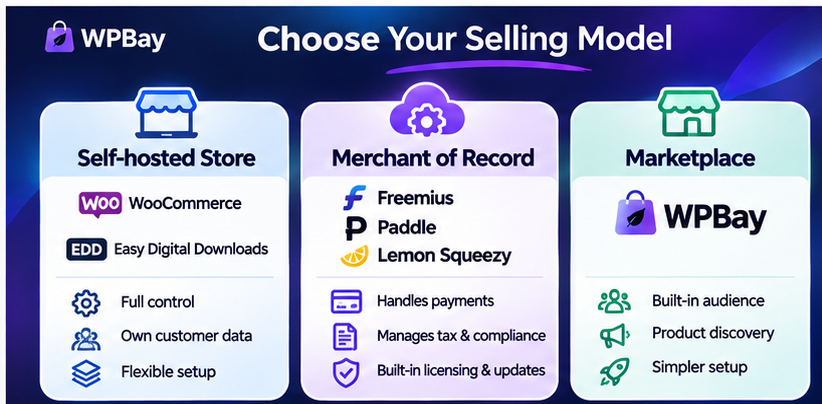
Self-hosted store versus Merchant of Record
This distinction deserves attention because WordPress developers often underestimate the work involved in selling software internationally.
When you operate your own WooCommerce or EDD store as the legal seller, you generally remain responsible for understanding the relevant sales taxes, invoicing, consumer rules, refund obligations and other requirements.
Payment gateways process payments but do not automatically take over every legal and tax responsibility of the seller.
A Merchant of Record instead acts as the seller for transactions within its supported arrangement and assumes specified commercial and tax responsibilities.
Freemius, Lemon Squeezy, Paddle and WPBay offer Merchant of Record models, although their exact scope and services differ.
For a developer with international customers, that can substantially reduce operational complexity.
However, Merchant of Record coverage does not eliminate every legal responsibility you have as a software publisher, including intellectual property obligations, product security and applicable data protection rules.
Can you migrate from Freemius to another platform?
Migration is possible in principle, but it can be more complicated than replacing a checkout button.
You need to examine the existing licensing, subscription and customer relationships before switching providers.
Existing licenses
Your plugin may use the Freemius SDK for license activation, premium feature access and updates.
If you replace it, existing customers still need a reliable way to receive the products and updates they purchased.
You may need a transition period that supports both old and new licenses.
Active subscriptions
Recurring billing arrangements are especially sensitive.
Do not assume that subscription payment credentials can be exported and imported between unrelated payment providers.
Migration may require coordination with the existing provider, the receiving provider and the underlying payment processor. Some customers may need to authorize new billing arrangements.
Customer records and privacy
Any customer-data export or migration must comply with applicable contractual, privacy and security requirements.
Ensure the receiving system only receives information necessary for the legitimate transition.
Automatic updates
A plugin formerly using Freemius for updates may need a new update client or a compatibility layer.
Test the change carefully across supported WordPress versions, staging websites, multisite installations and expired licenses.
An unsuccessful update migration can leave customers unable to receive security fixes.
A safer migration approach
Start by auditing the existing system and mapping license states, subscription states, product plans and customer entitlements.
Build the replacement integration and test it without disrupting production customers.
Run appropriate compatibility testing, establish a transition and rollback plan, then communicate changes clearly.
Only retire the previous system once you have verified that the relevant customer obligations continue to be met.
Which Freemius alternative should you choose?
There is no universal winner.
Choose Easy Digital Downloads if you want a self-hosted WordPress store and established WordPress software licensing, and are prepared to manage the commercial infrastructure.
Choose WooCommerce if you already use WooCommerce successfully and want to add software licensing through compatible extensions.
Choose Lemon Squeezy if hosted checkout and tax handling matter more than having a WordPress-specific monetization SDK.
Choose Paddle if you want a Merchant of Record billing platform and have the technical resources to connect it with your own plugin licensing and update systems.
Choose WPBay if you want to make your plugins available through a specialized WordPress marketplace with managed commerce, licensing and updates.
Choose a custom licensing system if existing products cannot satisfy your requirements and you can afford to build and maintain the infrastructure.
And importantly, staying with Freemius may still be your best option, especially when you already have working subscriptions, in-dashboard licensing and update delivery.
Switching platforms introduces costs and risks of its own.
Frequently asked questions
What is the cheapest Freemius alternative?
The answer depends on sales volume, transaction size, software licensing requirements and operating costs. A self-hosted solution can have lower variable platform fees, but requires hosting, payment processing, maintenance and potentially paid extensions. Compare total annual costs rather than advertised percentages alone.
Is Easy Digital Downloads better than Freemius?
EDD is better suited to developers who want a WordPress-based storefront under their own operational control. Freemius is often simpler for developers who want managed billing, taxes, licensing and WordPress updates through an integrated service.
Can WooCommerce replace Freemius?
WooCommerce can provide the store and payment infrastructure, but you need additional extensions or custom code to replace Freemius’s full licensing, update and subscription capabilities.
Does Paddle support WordPress plugin licensing?
Paddle provides payment and subscription infrastructure, but WordPress plugin license activation and automatic update delivery require a separate implementation or integration.
Is Lemon Squeezy a Merchant of Record?
Yes. Lemon Squeezy advertises a Merchant of Record service that handles applicable global tax collection and remittance for supported transactions.
Can I sell the same plugin on Freemius and WPBay?
Potentially. WPBay supports non-exclusive selling, and Freemius does not generally require exclusive distribution. However, you must ensure that licenses, purchase records, payment entitlements and update handling work correctly for each channel.
Does WPBay replace my own website?
No. WPBay is an additional marketplace channel. Developers can maintain their own sites and other distribution channels where the applicable terms allow.
Should I migrate existing Freemius subscriptions?
Not solely to reduce a percentage fee. First calculate the actual savings, development effort, payment migration risk and potential customer disruption. For many established businesses, retaining existing customers on their current billing system while testing a new channel may be more practical.
Final thoughts
Freemius alternatives should be evaluated as business systems, not simply as cheaper checkout providers.
Easy Digital Downloads and WooCommerce offer control over your own WordPress storefront. Lemon Squeezy and Paddle simplify global commercial transactions. Custom licensing gives you flexibility at the cost of ongoing engineering work.
WPBay offers something different: a WordPress-focused marketplace where developers can publish products, provide licensing and updates, and potentially reach additional customers without building the marketplace infrastructure themselves.
For many WordPress businesses, the best strategy may involve multiple channels rather than replacing one platform entirely.
If you’re considering adding another distribution channel for your WordPress plugins or themes, learn how to start selling on WPBay.
Official sources
- Freemius pricing
- Easy Digital Downloads pricing
- WooCommerce API Manager
- Lemon Squeezy pricing
- Paddle pricing
- WPBay seller pricing
- WPBay seller guidelines
Last reviewed: November 11, 2026. This comparison is published by WPBay, one of the marketplaces discussed above.