


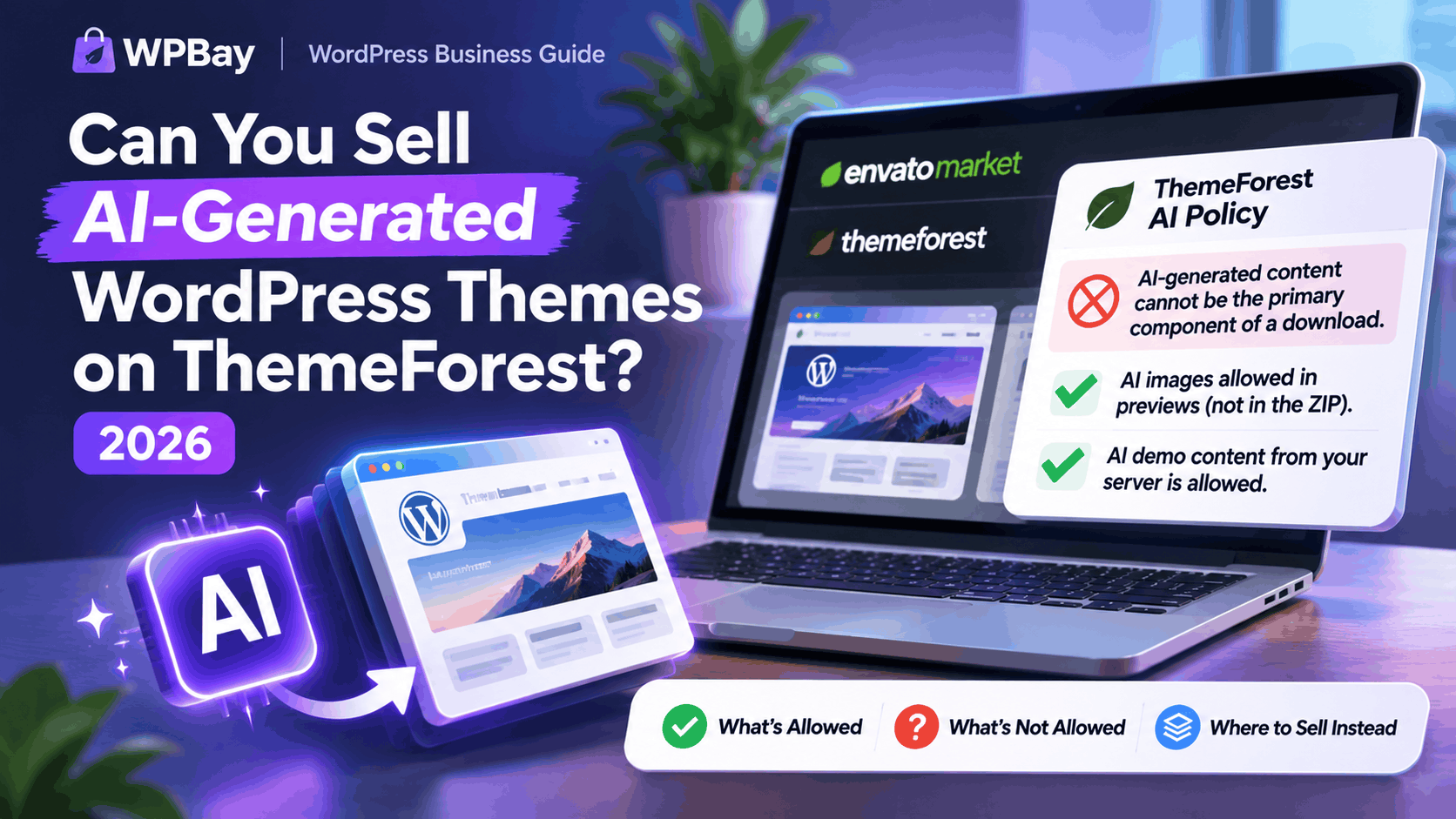
Short answer: ThemeForest does not permit AI-generated content to be sold as the primary component of a downloadable theme. Envato’s official AI-generated content policy allows AI-generated assets in item previews, but places restrictions on what can be included in the files delivered to customers.
This matters because AI coding assistants such as ChatGPT, Claude, Cursor and GitHub Copilot have made it easier than ever to build WordPress themes. A developer can now generate PHP templates, CSS, block patterns and JavaScript functionality in considerably less time than before.
But just because a theme works, and the AI tool allows commercial use, doesn’t mean every marketplace will accept it.
In this article, we’ll examine ThemeForest’s AI policies as of November 2026, what they mean for WordPress developers, the difference between AI-assisted and AI-generated products, and the alternatives available to developers who want to sell their work.
What is ThemeForest’s policy on AI-generated WordPress themes?
ThemeForest is part of Envato Market, and its authors are subject to Envato’s AI-generated content policy.
According to Envato’s official AI-generated content policy for Market and Elements, updated May 18, 2026, authors may not submit AI-generated content as a standalone product or as the primary component of an item’s final download.
The policy applies across Envato Market and Elements, including WordPress themes sold through ThemeForest.
Envato explains that these restrictions are related to intellectual property and licensing concerns. Authors must have the necessary rights to distribute their products and warrant that buyers can use them without infringing third-party rights.
AI-generated output can complicate those obligations, particularly when its provenance and similarity to existing copyrighted material are uncertain.
The policy distinguishes between two things: content included in the files customers download and content used only to preview a product.
That distinction is especially important when preparing a WordPress theme for sale.
What AI-generated content is allowed on ThemeForest?
Envato’s written policy establishes several scenarios.
| Scenario | ThemeForest policy implications |
|---|---|
| Selling a theme whose primary downloadable content is AI-generated | Not permitted under the published AI-content policy |
| Using AI-generated images in a preview | Permitted when properly licensed and not included in the download |
| Including AI-generated images in the downloadable theme | Not permitted under Envato’s preview-only rule for AI-generated content |
| Importing AI-generated demo content from your own server | Explicitly described as permissible under the policy, provided it is not included in the theme ZIP |
| Using AI to assist with debugging or development | Not separately addressed as a blanket prohibition; compliance depends on the resulting product |
| Selling a manually developed theme that uses limited AI assistance | Not automatically prohibited by the wording of the AI policy, but the finished submission must comply with all requirements |
The last two scenarios require care.
Envato’s public guidance does not establish a universal percentage of AI-generated code that is acceptable in a downloadable WordPress theme.
It would therefore be misleading to claim that a theme becomes acceptable simply because a developer manually edits a certain percentage of its code.
If AI-generated material forms the primary component of the downloadable product, the published prohibition applies. When the degree of AI involvement creates uncertainty, authors should request clarification from Envato before submitting the theme.
Can you use AI-generated images in a ThemeForest demo?
Yes, subject to Envato’s conditions.
The policy allows AI-generated preview images when the author holds the required commercial usage rights and the assets are not included in the customer’s downloaded package.
For example, a developer might use AI-generated photographs to illustrate how a restaurant WordPress theme could look with finished content.
Those images can appear in the online preview, but the developer must not simply bundle the same AI-generated photographs into the theme ZIP.
Envato also specifically allows AI-generated content to be imported from the author’s server as demo content, provided it is not included in the downloadable archive.
This exception should not be interpreted as permission to ignore licensing obligations, misrepresent included assets or distribute content that violates other rules.
Read the current policy before relying on this exception for a commercial product.
AI-assisted development vs. AI-generated themes: what’s the difference?
There is an important practical difference between using AI as a development assistant and relying on AI to create the majority of a product.
Consider two WordPress theme projects.
Example 1: A developer uses AI to improve existing code
A WordPress developer builds a custom block theme, writes the theme’s templates, creates its design system and develops its core functionality.
During development, the author uses an AI assistant to explain a WordPress API, suggest a CSS improvement, identify a PHP bug or help write a unit test.
The developer reviews the suggestions, verifies the code and remains responsible for the finished work.
That is AI-assisted development.
It does not automatically make the entire theme an AI-generated product, although any generated material incorporated into the final download still requires appropriate review and must comply with the marketplace’s rules.
Example 2: AI generates an entire WordPress theme
A developer asks an AI agent to build a complete multipurpose WordPress theme, generating the PHP templates, CSS, JavaScript, design patterns, configuration files and documentation.
The developer packages the generated output and submits it for sale.
If AI-generated material is the primary component of the downloadable product, that is precisely the kind of submission Envato’s published restriction addresses.
Manually installing the theme, correcting a few bugs or changing the product name does not establish that the downloadable product complies.
What if you manually rewrite part of the AI-generated code?
There is no published percentage threshold that guarantees acceptance.
The relevant questions are the nature of the finished product, whether AI-generated material remains its primary component, whether the author has appropriate rights, and whether all other submission requirements are satisfied.
A developer who is unsure should contact Envato Author Support with an accurate description of the development process.
Can an AI-generated theme pass ThemeForest’s technical review?
Technical quality and AI-content compliance are separate issues.
Even if a WordPress theme has clean PHP code, responsive layouts, fast loading times and a professional design, it can still conflict with Envato’s AI-content policy.
Likewise, a product that complies with the AI policy is not guaranteed to pass ThemeForest’s technical or editorial review.
Envato’s Theme Item Preparation and Technical Requirements establish requirements for preparing downloadable items, documentation, titles and related submission materials.
A serious WordPress theme developer should also test the theme against WordPress coding, security, compatibility and licensing expectations.
AI-generated code deserves particular scrutiny because generated implementations can contain subtle problems even when the website appears to function correctly.
Common risks include missing output escaping, improper input sanitization, unavailable WordPress functions, JavaScript errors, incompatible dependencies and features that work only with the demo configuration.
For example, an AI-generated settings page might register options without appropriately validating or sanitizing submitted values.
A generated template might output user-controlled content without using suitable WordPress escaping functions such as esc_html(), esc_attr() or esc_url().
A professional developer should detect and correct these issues before distributing a commercial theme.
Passing automated code checks does not override a marketplace’s AI-content restrictions.
Where can you sell AI-generated WordPress themes instead?
Developers who use AI extensively are not necessarily limited to selling services or distributing their work for free.
However, every distribution channel has its own rules.
1. WPBay
WPBay is a marketplace for WordPress plugins, themes and related software.
Unlike ThemeForest’s published restriction on AI-generated content as the primary downloadable component, WPBay explicitly permits AI-assisted and AI-generated code.
According to the WPBay Seller Guidelines, sellers remain responsible for their products’ security, functionality, performance, licensing compliance and ongoing maintenance.
AI-generated submissions are reviewed against the same quality expectations as manually developed software.
This means you can submit an AI-generated WordPress theme for consideration, provided the product is functional, legally distributable and meets the marketplace’s technical and editorial requirements.
It does not mean that every automatically generated theme will be approved.
WPBay may reject products containing security vulnerabilities, unfinished functionality, licensing problems, misleading descriptions or other quality issues.
Developers should also read WPBay’s guidance on third-party and AI-generated assets before packaging their themes.
The key difference is that WPBay evaluates AI-generated code based on compliance and product quality rather than prohibiting it solely because AI generated the primary code.
2. Your own WordPress or WooCommerce website
Another option is selling your theme directly through your own website.
WooCommerce and digital-product selling systems can provide the storefront and checkout foundation, while appropriate licensing and update-delivery systems handle access to future versions.
This approach gives you greater control over pricing, customer acquisition, branding and the purchasing experience.
However, you must manage the operational and legal aspects yourself or through selected service providers.
These may include payment processing, tax compliance, refunds, software licensing, download security and customer support.
Operating your own store does not remove intellectual property obligations or the need to verify AI-generated material.
3. WordPress.org for free distribution
The official WordPress.org Theme Directory is an option for distributing themes free of charge.
It is not a direct paid-theme marketplace, and it has its own review requirements.
The WordPress Theme Review Guidelines cover licensing, security, theme functionality, internationalization and other areas.
Themes must comply with the applicable requirements regardless of which tools were used during development.
WordPress.org’s rules should not be confused with ThemeForest’s AI-content policy. They are separate distribution channels with separate review processes.
A free theme may also serve as an introduction to a related commercial product, provided the developer follows WordPress.org’s rules for upselling, licensing and external links.
What should you check before selling an AI-generated WordPress theme?
Regardless of where you sell, your theme should be a reliable, maintainable product rather than an untested collection of generated files.
Verify the code actually works
Install the theme on a clean WordPress website and test it without relying on development-only plugins or previously configured settings.
Check a fresh installation, theme activation, navigation, content templates, responsive layouts and any customization interfaces.
If the theme supports WooCommerce, Elementor or other third-party integrations, test those integrations with the versions you actually claim to support.
Avoid advertising compatibility that you haven’t verified.
Check WordPress security practices
Examine every place where the theme accepts data, displays output, accesses the database or communicates with external services.
Review appropriate sanitization, validation, escaping, permissions and nonce handling wherever relevant.
Do not assume an AI coding assistant implemented these protections correctly.
Audit licensing and third-party assets
Confirm that you have the rights required to distribute the theme and everything bundled with it.
This includes libraries, fonts, icons, stock photography, illustrations, templates and demo content.
AI tools can generate material resembling existing products or protected designs. A commercial-use permission from an AI provider does not guarantee that the output is free from third-party rights issues.
For WordPress themes, GPL compatibility and other applicable license obligations must also be respected.
Test accessibility and performance
A professional WordPress theme should remain usable on different devices and with common accessibility tools.
Review heading structure, keyboard navigation, focus states, color contrast, responsive behavior and image handling.
Measure performance with representative demo content. Avoid loading unnecessarily large scripts, stylesheets or media resources on every page.
Prepare accurate documentation
Customers should understand how to install the theme, import any supported demo content, configure required plugins and customize the design.
Explain which assets are included and which are preview-only.
If your product uses external APIs or services, document those dependencies and any additional costs.
Documentation should describe the actual released functionality, not features an AI model intended to implement but never finished.
Be ready to maintain the theme
Selling a WordPress theme creates ongoing expectations around compatibility, security fixes and customer support.
WordPress changes over time. WooCommerce, page builders and PHP versions also evolve.
A product that works today may need adjustments after a major update.
If you cannot understand and maintain the generated code, you are not ready to sell it as a supported commercial theme.
Can you sell themes built with ChatGPT, Claude, Cursor or GitHub Copilot?
The tool’s name is not the deciding factor.
A theme built with ChatGPT is not automatically acceptable or unacceptable everywhere. The same applies to Claude, Cursor, GitHub Copilot and other AI development tools.
For ThemeForest, the relevant issue is whether the submission complies with Envato’s restrictions on AI-generated content in downloadable products.
For WPBay, AI-generated code is permitted, but the resulting product must meet the site’s quality, security and licensing expectations.
For a self-hosted store, the developer must ensure the right to distribute the product and comply with applicable laws and third-party licenses.
In every case, the author remains responsible for what the software does.
Will ThemeForest change its AI policy?
Possibly, but future changes should not be assumed.
Envato’s published AI-content policy acknowledges that its rules may be updated as the field develops.
Developers planning a new commercial WordPress theme should review the latest version of the policy before investing heavily in a product designed specifically for ThemeForest.
An article or forum discussion from 2024 or 2025 may no longer describe the applicable rules.
The official policy is a more reliable reference than speculation about which AI tools Envato can detect.
Frequently asked questions
Does ThemeForest ban all AI-assisted WordPress themes?
Envato’s policy prohibits AI-generated content as a standalone item or the primary component of a downloadable product. It does not separately state that every use of AI for debugging, research or development assistance is prohibited. Authors should seek clarification where their use case is uncertain.
Can I use ChatGPT to write PHP code for a ThemeForest theme?
Using an AI tool for code assistance is not addressed by a universal ban on all developer interactions with AI. However, the finished submission must comply with the policy restricting AI-generated downloadable content. Do not assume that generated code is acceptable merely because it was edited or tested.
Can I include AI-generated demo images in a ThemeForest ZIP?
Envato’s published policy says AI-generated content may be used for previews but must not be included in the downloaded files. It also describes a server-hosted demo-import exception. Always check licensing conditions and current guidance.
Can I sell a completely AI-generated WordPress theme on WPBay?
You can submit an AI-generated theme for review. WPBay permits AI-generated code but requires the same quality, security, functionality and licensing standards that apply to manually developed themes. Approval is not guaranteed.
Does WordPress itself prohibit AI-generated themes?
WordPress.org has its own theme review and licensing requirements. Those are separate from Envato’s policy. Developers must comply with the rules of whichever distribution channel they choose.
Is AI-generated WordPress code automatically copyright-free?
No. Copyright treatment varies by jurisdiction, and AI output can contain material that conflicts with third-party rights. Always check licensing, provenance and commercial distribution rights before releasing a product.
Will ThemeForest reject a theme because I used Cursor or GitHub Copilot?
The published policy focuses on AI-generated content submitted or included as the primary component of an item. It does not establish a blanket rule that simply opening an AI coding assistant requires rejection. The specific content and its compliance matter.
Final thoughts
AI has changed how WordPress themes can be developed, but it hasn’t eliminated marketplace policies, software maintenance responsibilities or intellectual property requirements.
As of November 2026, ThemeForest’s official policy does not permit AI-generated content to be the primary component of a downloadable theme.
AI-generated images may be used for previews under the published conditions, while developers using AI for coding assistance should assess the resulting product carefully and seek clarification from Envato where necessary.
For developers who want to sell AI-generated WordPress themes, WPBay provides an alternative approach: AI-generated code is allowed, but every product must still meet the marketplace’s quality, security and licensing requirements.
If you’ve built a WordPress theme with AI and are prepared to maintain and support it, explore selling your product on WPBay.
Official references: Envato AI-generated Content Policy, ThemeForest Technical Requirements, WPBay Seller Guidelines, WordPress Theme Review Guidelines.
Policy information reviewed November 10, 2026. Marketplace rules may change.