

For a long time, CodeCanyon offered WordPress developers something that was surprisingly difficult to build on their own: access to customers who were already looking for software. You developed a plugin, submitted it for review, and if it was accepted, your product became part of a marketplace where people arrived with the intention of buying.
That model worked particularly well for independent developers. You didn’t need a marketing department, a complicated checkout system, or an established brand to make your first sales. A useful plugin with a good demo and a convincing description could attract customers without much promotion outside the marketplace.
The difficulty was that you never really controlled the source of those sales. A change in search visibility, marketplace policies, customer behavior, or commission structures could affect your income even if your plugin continued to work perfectly. Many developers spent years improving their products while investing relatively little in building an audience they could reach independently.
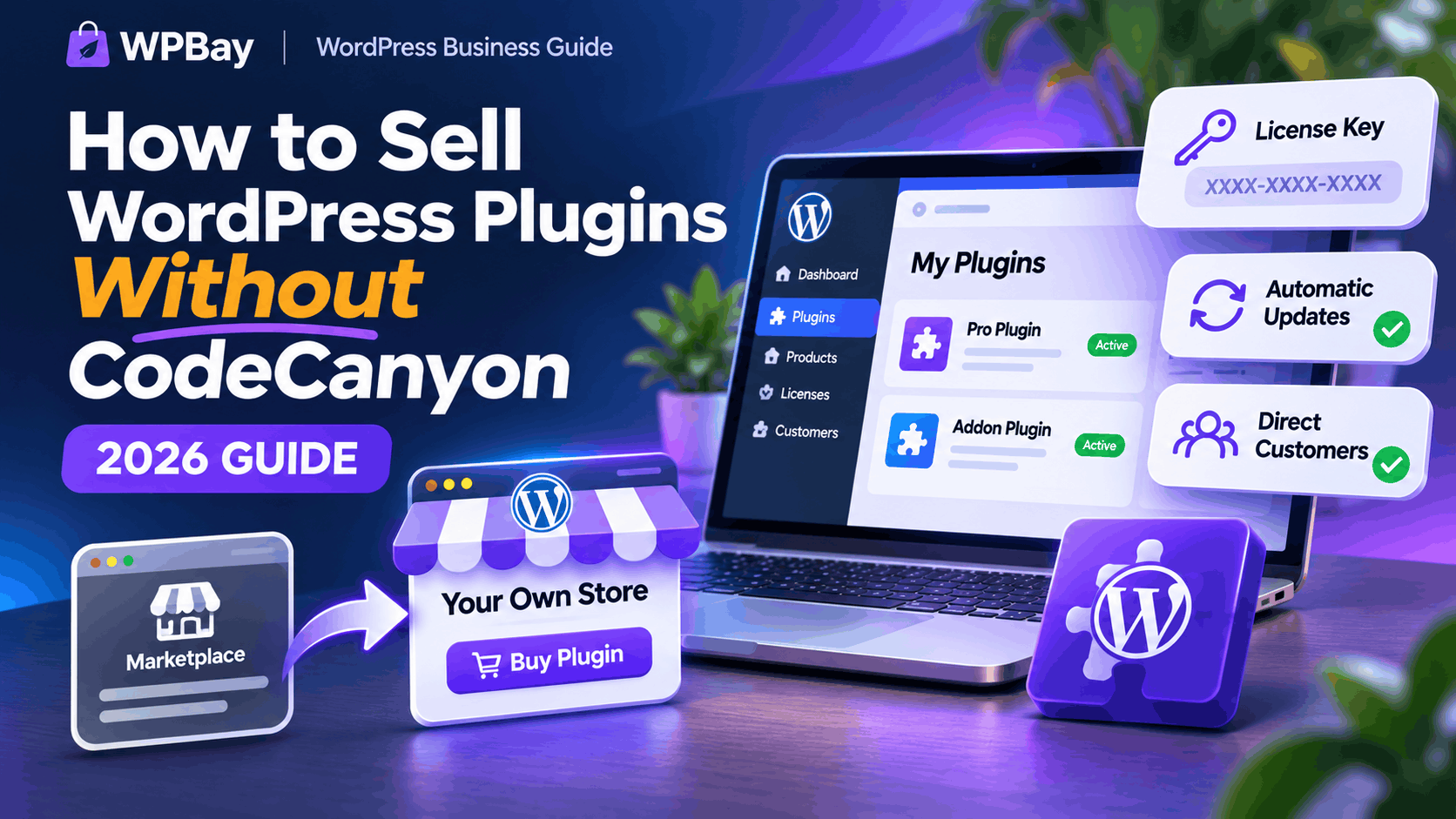
Selling WordPress plugins without CodeCanyon is entirely possible in 2026, but it involves more than moving a download button to another website. You need to replace the commercial infrastructure the marketplace provided, find your own customers, and give them enough confidence to purchase software from a developer they may never have heard of.
The good news is that most of the technical pieces already exist. The harder part is putting them together into a business that can support itself over time.
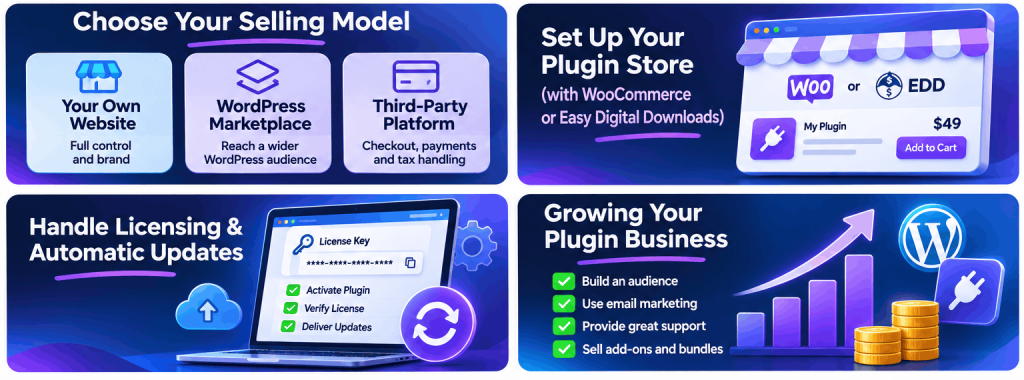
The real difference between selling on CodeCanyon and selling independently
When you sell through a marketplace, you’re effectively exchanging part of your revenue and some control over the sales experience for access to its infrastructure and audience. The marketplace provides product discovery, checkout and a familiar purchasing environment. You concentrate on developing the product, preparing its documentation, releasing updates and answering customer questions.
With independent sales, the responsibilities are divided differently. Your website becomes the storefront, your brand becomes the reason customers trust the product, and your marketing determines how many people discover it. You also need a reliable way to accept payments, generate software licenses, distribute updates and deal with renewals.
This doesn’t necessarily mean doing everything yourself. You can use a hosted service for payments and licensing, run WooCommerce or Easy Digital Downloads on your website, or distribute through a smaller marketplace. What matters is understanding which parts of the business remain under your control and which parts depend on another company.
There’s also a misconception worth addressing: earning a higher percentage from each sale doesn’t automatically make independent selling more profitable. A developer who retains 95% of a sale but spends $25 acquiring the customer may earn less than someone paying a substantial marketplace commission for a sale that required no direct advertising expenditure.
The real benefit of independence is the ability to build several sources of revenue rather than relying entirely on one marketplace.
Start with your own website, even if you don’t sell directly yet
If you’re planning to build a WordPress plugin business outside CodeCanyon, your own website should become its central point of reference. It doesn’t need to be a complicated ecommerce store from the beginning, but it should clearly explain your products, provide documentation, offer support and establish who is responsible for the software.
Consider what happens when someone discovers your plugin through a YouTube tutorial or Google search. They may want to know whether it works with the latest WordPress version, how frequently it receives updates, what happens when their license expires, and whether anyone will help if something goes wrong. These questions are often more important than a small difference in price.
A proper product page should answer them without making the visitor search through several websites. Show the plugin working in a real WordPress installation, explain the main use cases, publish a meaningful changelog and include documentation that reflects the current release. Screenshots should demonstrate actual functionality rather than an idealized interface that customers cannot reproduce.
It’s also worth keeping the product website separate from whichever payment provider you use. If you later replace Freemius, move from WooCommerce to another checkout, or add a marketplace listing, your documentation, search traffic and brand can remain in the same place.
For developers with several plugins, this becomes especially valuable. Someone who buys one product may eventually need another, but that relationship is difficult to develop if your business has no recognizable identity outside its marketplace listings.
Choosing how to sell your plugins
There are three realistic approaches for most independent WordPress developers: operating your own store, outsourcing commercial infrastructure to a software monetization service, or using an independent marketplace. Each solves a different problem, and the right choice depends on how much technical and administrative work you’re willing to handle.
Selling with Easy Digital Downloads
Easy Digital Downloads is a natural option for developers who want their own WordPress-based store. It’s built around digital products rather than physical inventory, and its software licensing functionality is designed for products such as premium WordPress plugins and themes.
With a suitable EDD plan, you can manage downloads, issue licenses, limit activations and deliver updates to customers. The checkout and customer records live within the WordPress environment you operate, which makes it appealing to developers who want to integrate sales with their existing website.
The advantage is flexibility. You control the presentation of your products, can create your own onboarding experience and aren’t required to send visitors to a separate marketplace. This can be useful when your website already attracts organic traffic or you have an established mailing list.
The disadvantage is that you become responsible for maintaining the store as well as the plugin. WordPress updates, payment integrations, hosting, backups, security and tax obligations all need attention. EDD provides software to run a digital store; it doesn’t automatically become the legal seller responsible for every transaction.
For an established developer who is comfortable managing WordPress infrastructure, those responsibilities may be perfectly reasonable. For someone who wants to spend almost all their time writing plugin code, they may be an unnecessary distraction.
Selling with WooCommerce
WooCommerce can also serve as the foundation for an independent plugin business. This makes particular sense if you’re already using WooCommerce and have customized its checkout, analytics or customer management workflows.
The important distinction is that WooCommerce itself is an ecommerce platform, not a complete premium plugin licensing service. Selling a downloadable ZIP is straightforward, but providing license keys, activation limits, automatic updates and subscription-based entitlements requires additional extensions or custom development.
Products such as API Manager for WooCommerce are intended to fill part of that gap. Before committing to a particular extension, however, check how it handles the full customer lifecycle rather than simply whether it can generate a license key.
You need to know what happens when a payment fails, a subscription is cancelled, a customer moves their website to another domain, or someone requests a refund. These situations may not appear important when you’re making your first few sales, but they become regular support questions once you have hundreds of customers.
WooCommerce is a capable foundation if you already know its ecosystem and have a reason to customize your commercial workflows. Starting a WooCommerce store solely because the core plugin is free can be a false economy if you subsequently need several paid extensions and substantial development work.
Selling with Freemius
Freemius takes a different approach. Rather than requiring you to operate a complete ecommerce and licensing system, it provides much of the infrastructure as a managed service. For WordPress developers, that includes checkout, software licensing, automatic updates, subscriptions and integration tools.
Freemius also operates as a Merchant of Record for supported transactions, meaning it takes responsibility for specified payment and tax obligations that would otherwise need to be handled by the seller or another provider.
Its pricing changed in October 2026. The published starting rate for its full WordPress solution is 6.1% plus $0.50 per transaction, with payment gateway fees charged separately. The percentage can change with its progressive pricing structure, so the current pricing page should be consulted before making financial projections.
For a plugin sold at $59, the initial platform fee at that rate works out to approximately $4.10, excluding gateway costs and other possible adjustments. That may be attractive compared with building and maintaining a custom billing and licensing system, particularly for a solo developer.
The tradeoff is dependence on Freemius’s platform and integration architecture. If you decide to migrate later, existing customer licenses, subscriptions and update mechanisms may require careful handling. It’s sensible to understand those dependencies before adopting the service rather than discovering them when you already have thousands of active licenses.
None of these approaches is universally better. EDD and WooCommerce offer greater control over a self-hosted storefront, while Freemius reduces the amount of commercial infrastructure you need to maintain. Your decision should reflect the stage of your business, not just the fee advertised on the pricing page.
Don’t overlook independent WordPress marketplaces
Building your own store doesn’t mean you have to stop using marketplaces entirely. In fact, using multiple compatible distribution channels can be a sensible way to reduce dependence on any one company.
WPBay is an example of a WordPress-focused marketplace where developers can list plugins, themes and related software. It provides marketplace checkout, licensing and update infrastructure, along with Merchant of Record handling for marketplace transactions.
Unlike a checkout service that primarily processes customers you bring yourself, WPBay also provides a place where potential buyers can discover products. That distinction is important because customer acquisition is usually the biggest challenge when moving away from a large marketplace.
WPBay operates with progressive seller commissions. New sellers retain 70% of standard sales, with the percentage increasing as they reach published sales milestones, up to 88% at the highest tier. These commissions are considerably larger than the transaction fees charged by some standalone checkout services, but the comparison is not entirely equivalent because a marketplace includes a distribution channel.
There’s no reason to pretend that a listing on a newer marketplace will automatically replace the sales volume a product previously received on CodeCanyon. A developer still needs a quality product, a convincing description, documentation and a willingness to support customers. Marketplace visibility can help, but it shouldn’t be treated as a substitute for marketing.
The useful part is that WPBay supports non-exclusive distribution, subject to its seller terms. Developers can maintain their own websites and other permitted channels while using WPBay as an additional place to sell.
Read more about selling WordPress plugins on WPBay.
Disclosure: WPBay publishes this article and operates one of the marketplaces discussed here.
Licensing is where a simple plugin sale becomes a software business
It’s easy to underestimate the importance of licensing when you have only a handful of customers. You might initially think that delivering a ZIP file after payment is enough, especially for a relatively simple plugin.
That approach becomes harder to manage once customers expect license renewals, automatic updates, activation limits and access to previous purchases. It becomes more complicated still when you offer different plans for one website, five websites or unlimited installations.
A typical licensing system connects a purchase to a customer account and issues an entitlement that the plugin can recognize. The plugin communicates with the licensing service when a customer activates or deactivates a website, checks license status or requests an update.
The implementation should account for ordinary WordPress behavior. Customers clone production websites to staging environments, change domains, restore backups and migrate hosting providers. Your licensing logic needs a clear policy for these situations rather than treating every domain change as suspicious activity.
There’s another design decision that affects customer trust: what happens when a license expires? Some developers allow their plugin to continue operating while restricting updates and support. Others restrict certain services that require ongoing paid infrastructure. Whatever model you choose, the behavior should be explained before purchase and implemented consistently.
A temporary outage of your licensing server should not unexpectedly disable a customer’s website. Good licensing systems consider caching, error handling and reasonable grace periods so that routine network problems don’t turn into urgent support incidents.
If you’re building the licensing infrastructure yourself, you’ll also need secure update delivery, authenticated API requests, protection against abuse and reliable synchronization with your payment system. For most small developers, using a maintained licensing service is more efficient than implementing these features from scratch.
Annual licenses, lifetime deals and the cost of support
Independent selling also means deciding how your product should be priced. CodeCanyon’s traditional purchasing experience shaped customer expectations around one-time licenses, but your own store doesn’t have to follow the same model.
Annual subscriptions are appealing because they connect ongoing revenue with ongoing development work. WordPress changes, PHP changes, WooCommerce changes, and external APIs sometimes disappear or introduce breaking changes. A plugin that customers depend on can require years of maintenance after its initial release.
However, subscriptions aren’t automatically the right answer for every product. A small utility with limited ongoing dependencies may be suitable for a one-time purchase, while a complex integration that requires constant compatibility updates and external services may need recurring revenue to remain sustainable.
Lifetime licenses can generate immediate income and appeal to customers who dislike subscriptions, but they also create long-term obligations. If you sell a lifetime license for $99 and a customer continues using the plugin for eight years, the initial payment must somehow cover the development, infrastructure and support associated with that customer.
The problem becomes particularly noticeable when support is expensive. A customer who submits several detailed tickets may consume a large portion of the revenue from their purchase, regardless of how much time has passed since they bought the product.
Before setting prices, estimate how much work the average customer creates and how much ongoing maintenance the product requires. Pricing based only on competitors can leave you with a growing customer base that becomes increasingly difficult to support profitably.
The hardest part: finding customers without CodeCanyon
Once your checkout, licenses and update system are working, you have solved the technical problem of independent selling. You haven’t necessarily solved the business problem.
A marketplace can bring customers to you. Your own website usually cannot, at least not until you’ve built some visibility.
This is where many developers discover that writing a good plugin and marketing one are very different skills. You can spend months refining an interface, improving performance and adding features while almost nobody outside your existing customers knows the product exists.
One approach that works particularly well for WordPress software is publishing tutorials around specific problems. People rarely search Google for a plugin they’ve never heard of. They search for things like adding custom fields to WooCommerce products, importing content from an external website, fixing a WordPress automation issue or connecting a particular API.
If your plugin addresses that problem, a useful tutorial gives you an opportunity to demonstrate it in context. The article shouldn’t be a disguised advertisement. It should explain the problem, show a working solution and help the reader understand when your product is appropriate.
The same principle applies to YouTube. A video showing the actual plugin in a WordPress dashboard can answer questions that several paragraphs of marketing copy cannot. Viewers can see what the interface looks like, how complicated the setup is and whether the result matches what they need.
Documentation can also attract search traffic. Detailed guides explaining configuration, troubleshooting and integrations may rank for very specific queries while reducing the number of support requests you receive.
Over time, these resources become more valuable because they belong to your business. You aren’t relying solely on how prominently one marketplace decides to display your product.
Can a free WordPress.org plugin help you sell a premium version?
For some types of products, publishing a free version on WordPress.org can be one of the most effective ways to introduce the plugin to new users.
A free version lets people test the basic functionality on their own websites before deciding whether they need a commercial edition. It also gives the developer an opportunity to collect legitimate feedback, improve compatibility and understand which features users value.
However, WordPress.org has strict rules about what can be distributed through its directory. The official plugin guidelines prohibit trialware that includes functionality in the directory-hosted plugin but keeps it locked behind a payment or upgrade. A common compliant model is to offer a genuinely functional free plugin and distribute additional premium functionality through a separate add-on or version.
You should also avoid turning the free plugin into an aggressive advertising system. Excessive admin notices, misleading upgrade prompts and unauthorized tracking can create problems for users and conflict with directory requirements.
A free plugin is most useful when it solves a real problem by itself. If users appreciate the free edition, they’re more likely to consider a premium product from the same developer when they need more advanced functionality.
The WordPress.org Plugin Directory Guidelines explain the relevant rules in detail.
How much more money do you actually keep?
Consider a hypothetical developer selling a premium WordPress plugin for $59. They have their own website, use a payment processor and pay no marketplace commission on direct sales.
If we assume payment processing costs of 2.9% plus $0.30, the fee on a $59 transaction would be approximately $2.01. The developer would retain about $56.99 before taxes, hosting, licensing software, support, advertising and other costs.
Compare that with a WPBay sale at the initial 70% seller share, which would generate $41.30 before exceptional adjustments. On the surface, the direct sale looks much more attractive.
Now introduce customer acquisition.
If the independent developer spends $20 on advertising to generate one $59 sale, the amount remaining after the assumed processing fee and advertising cost falls to approximately $36.99. That’s less than the $41.30 seller share from a marketplace sale that required no direct advertising expenditure.
These numbers are illustrative, and real transaction costs vary. They also don’t account for refunds, customer support, subscription renewals, or the value of customers who purchase additional products in the future.
The comparison demonstrates why commission percentages shouldn’t determine your entire selling strategy. Direct sales can be extremely profitable when customers arrive through organic search, existing relationships or recommendations. Marketplace sales can also make sense when they reach buyers who wouldn’t otherwise discover your software.
You don’t have to choose one and reject the other. The more useful question is how each channel contributes to your overall profitability.
Moving an existing CodeCanyon product to independent sales
If you already have a plugin on CodeCanyon, it’s worth treating the move as a gradual business transition rather than a simple change of download location.
Your existing customers purchased under particular marketplace licenses and support terms. Any new licensing system needs to respect the obligations attached to those purchases. You should also review your author agreement and exclusivity status before distributing the same product independently, since not every CodeCanyon arrangement permits identical distribution elsewhere.
The safest technical approach is to establish the new infrastructure before changing the existing one. Build your product website, test the checkout and licensing workflow, verify automatic updates and make sure customers can access documentation and support.
If your existing plugin relies on an Envato purchase code or marketplace-specific update mechanism, moving to another licensing system can require compatibility work. It may be appropriate to support both the old and new systems for a period, depending on the applicable obligations and your technical architecture.
Customer information deserves particular care. Don’t assume that historical marketplace buyers can simply be exported into a new marketing database or transferred to a different billing provider. Payment records, consent and customer communications need to follow the relevant contractual and privacy requirements.
It’s also worth considering what you gain by keeping an existing marketplace listing active. If the listing still generates sales and the terms permit your intended setup, there may be no immediate benefit to abandoning it. Independence doesn’t require removing every existing sales channel; it requires ensuring that your business can function without relying entirely on one of them.
What I would do if starting a WordPress plugin business today
I would start with one plugin that solves a specific, commercially relevant problem, rather than building a collection of unrelated products and hoping that a marketplace will discover them.
Before investing heavily in development, I’d look at whether people are already searching for the problem and whether existing solutions leave something important unresolved. A product doesn’t need to be revolutionary, but it should have a clear reason for existing beyond offering the same feature list as several competitors.
I’d then build a simple branded website with documentation, a working demo and a sales system that doesn’t require constant maintenance. If the product justified it, I’d offer a useful free version through WordPress.org, while keeping premium functionality in a separately distributed product.
For customer acquisition, I’d concentrate on demonstrating the plugin through tutorials, videos and practical examples rather than publishing large quantities of generic promotional content. A few detailed guides answering real questions can be more valuable than dozens of articles written simply to target keywords.
Finally, I’d test at least one additional distribution channel once the product was stable and well documented. An independent marketplace can reach a different audience, while the main website remains the long-term home of the brand.
The objective would be to create a business where customers discover the product for several different reasons, rather than because one platform happens to place it prominently in its search results.
Frequently asked questions
Can I sell WordPress plugins without CodeCanyon?
Yes. You can sell directly through your own website using WooCommerce or Easy Digital Downloads, use a managed platform such as Freemius, or list your products on independent marketplaces. The best approach depends on whether you want complete control over your sales infrastructure or prefer to outsource some of the operational responsibilities.
Do I need to build my own licensing system?
No. Freemius, EDD Software Licensing, compatible WooCommerce extensions and marketplace-provided licensing systems can handle much of the required functionality. Building a custom licensing server makes sense when you have unusual technical requirements or need integrations that existing solutions cannot support.
Can I sell the same plugin on CodeCanyon and another marketplace?
That depends on your CodeCanyon author agreement, exclusivity arrangements and the terms of the other marketplace. Always verify the applicable rules before listing identical products across several channels.
Are subscriptions better than lifetime licenses?
Subscriptions generally make it easier to fund ongoing development, while lifetime licenses provide more revenue upfront and can appeal to certain customers. Neither model is automatically better. The correct choice depends on the cost of maintaining the software, customer expectations and whether the product relies on services that generate continuing expenses.
How do I attract customers to my own WordPress plugin store?
Useful tutorials, search engine visibility, videos, documentation, recommendations and relevant partnerships are all potential channels. The most sustainable approach is to demonstrate how your plugin solves specific problems and build a brand customers can find independently of a marketplace.
Can I use WPBay alongside my own store?
Yes, subject to WPBay’s seller terms and applicable pricing requirements. WPBay supports non-exclusive distribution, allowing developers to maintain their own selling channels while also offering products through the marketplace.
Final thoughts
CodeCanyon made it relatively simple for developers to sell WordPress plugins because it combined a marketplace audience with the infrastructure needed to complete a sale. Replacing that system requires more than choosing another checkout provider, especially if you’ve spent years depending on marketplace traffic.
The most sustainable independent businesses develop their own identity, understand where customers come from and choose commercial tools that suit their products. They invest in software quality, documentation and support while gradually building distribution channels that they can influence and improve.
You don’t need to abandon marketplaces to achieve that independence. Your own website can remain the center of the business, while services such as Freemius, Easy Digital Downloads and independent marketplaces handle different parts of the sales process.
For developers interested in adding a WordPress-focused marketplace to their distribution strategy, WPBay offers a way to sell plugins and themes alongside other permitted channels.
The important thing is to build a plugin business that continues to attract and serve customers even when one particular marketplace stops delivering the results it once did.