

For years, ecommerce optimization followed a familiar path. Help somebody find a product page, make the page convincing, remove friction from checkout, and hope the customer completes the order.
AI shopping agents change the middle of that journey.
A buyer can now describe what they want in ordinary language: “Find me a waterproof hiking jacket under $150, available in medium, that can arrive before Friday.” An AI assistant can narrow the options, compare products and explain the trade-offs without sending the buyer through a dozen category pages. The next step is allowing that same assistant to prepare a cart or complete a purchase after the buyer approves it.
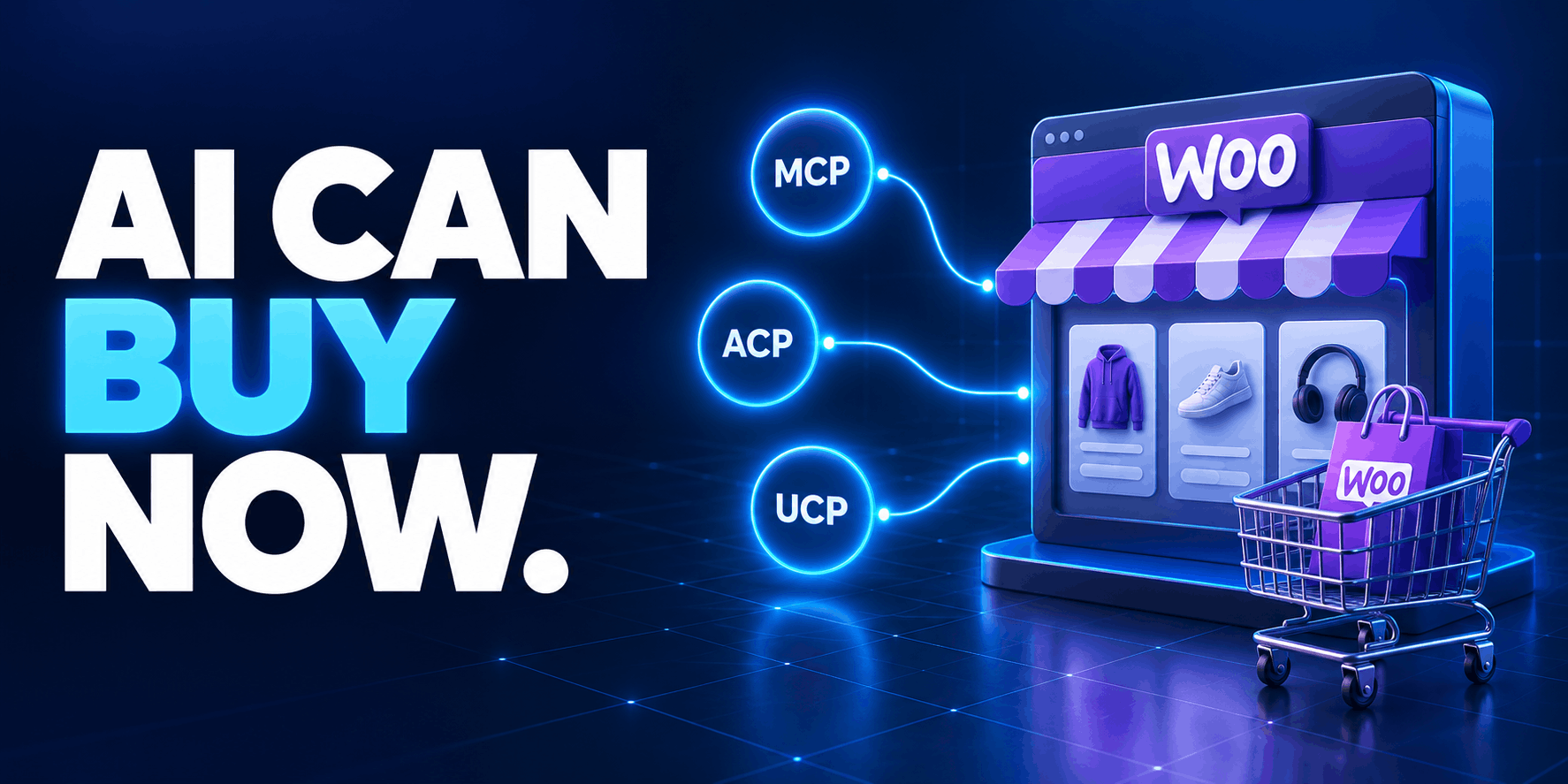
That is the basic idea behind agentic commerce for WooCommerce: a new route from product discovery to payment. It also introduces a pile of technical terms that are easy to mix up. MCP, ACP and UCP are often discussed as though they were three versions of the same thing. They are not.
MCP gives an AI application controlled access to tools and data. ACP is OpenAI and Stripe’s commerce protocol, used around product discovery and agent-ready checkout. UCP is a broader commerce standard led by Google and partners, with Google using it for buying through AI Mode and Gemini. A WooCommerce store may eventually use all three, but each one belongs in a different part of the system.
The more important point is less exciting than the protocol names: none of them can rescue a bad catalog. If product variations are ambiguous, stock is stale, identifiers change, or shipping information exists only in a paragraph on an obscure policy page, an AI agent cannot confidently recommend or buy the product. The stores best prepared for agentic commerce will be the ones with the cleanest product data and the most predictable checkout logic.
Agentic commerce begins before an agent tries to buy
The phrase “agentic commerce” makes people think about autonomous checkout, but a purchase starts much earlier. An agent first needs to discover that a product exists. It then needs enough reliable information to decide whether that product fits the buyer’s request. Only after those steps can it build a cart, calculate the real total and ask for permission to place the order.
Consider a variable WooCommerce product with four sizes and three colors. A person can open the product page and experiment with dropdowns. A machine needs something more explicit. It needs a stable identifier for every purchasable variation, the exact combination of attributes, the correct image, current availability and the price in the relevant currency. If the black medium jacket is sold out, the agent should not have to infer that from a disabled option rendered by JavaScript.
The same applies to policies. A recommendation may depend on whether the merchant ships to Romania, whether returns are free, whether a product contains a subscription, or whether delivery before Friday is realistic. These details influence the purchase as much as the product description does.
Traditional SEO still matters because public product pages remain evidence. Search engines and commerce platforms can compare a submitted feed with the page a buyer would visit. Structured data, canonical URLs, crawlable images and useful product copy continue to support discovery. Agentic commerce adds feeds, tool calls and transaction APIs on top of that foundation; it does not make the foundation disappear.
An “AI commerce” plugin can only translate the data it finds in WooCommerce. It cannot know that a badly named attribute should really contain material composition, or that the stock quantity imported yesterday is no longer correct.
MCP, ACP and UCP solve different problems
The names become easier to remember once they are tied to the job each protocol performs.
| Standard | What it is for | Likely WooCommerce role | Current practical limitation |
|---|---|---|---|
| MCP | Giving an AI client permission-controlled access to tools and data | Private product queries, catalog work, order operations and internal assistants | It does not submit products to public AI shopping results |
| ACP | Exchanging product and checkout data with compatible AI commerce platforms | ChatGPT product discovery and future agent checkout | Product-feed and checkout access still depend on OpenAI onboarding |
| UCP | Describing commerce capabilities across agents, merchants and payment providers | Google AI Mode and Gemini discovery and checkout | WooCommerce has no finished native UCP integration, and Google access is limited |
The Model Context Protocol is the broadest of the three. It was designed so AI applications can discover tools, understand their input schemas and call them. Those tools might search documents, query a database, edit a product or add a note to an order. MCP is not specifically an ecommerce standard, and it is not a replacement for a shopping feed.
The Agentic Commerce Protocol is narrower. OpenAI and Stripe developed it to help agents and merchants exchange the information needed for commerce. OpenAI’s current implementation begins with structured product data. Checkout is handled as a separate integration because showing a product and safely taking payment are very different levels of responsibility.
The Universal Commerce Protocol covers a wider commerce lifecycle. It can describe business capabilities, checkout, payments, identity and order handling. Google is using UCP for commerce experiences in AI Mode and Gemini, but the protocol itself is meant to be interoperable rather than a Google-only API.
MCP can sit beside ACP or UCP. A merchant might use MCP for an internal catalog assistant while using an ACP feed to make products eligible for ChatGPT discovery and a UCP adapter for Google checkout. There is no reason the checkout rules should be rebuilt three times. Each external interface should eventually call the same WooCommerce pricing, inventory, tax, shipping and order logic.
What WooCommerce actually supports today
The current WooCommerce position is promising, although it is earlier than some headlines suggest.
WooCommerce introduced its first MCP integration with WooCommerce 10.3. The current WooCommerce MCP documentation calls it a developer preview, which matters. The feature is usable for testing, but developers should expect schemas and integration patterns to evolve. It exposes purpose-built product and order abilities through the WordPress Abilities API and the WordPress MCP Adapter.
Woo has also confirmed that it is experimenting with OpenAI’s product feed specification and working around ACP. Its agentic commerce roadmap describes product discovery and secure transactions as the two main parts of the problem. That is a direction of travel, not a promise that every WooCommerce store can activate native ChatGPT checkout today.
UCP is less mature inside WooCommerce. As of September 11, 2026, the request for native UCP support remains open. A developer can build an adapter, but Google’s buying experience also requires merchant approval and conformance with Google’s checkout requirements. Publishing a JSON file under .well-known does not place a store in the program.
The distinction between software support and platform access is important. A store can generate a technically valid ACP feed without being an approved OpenAI product-feed partner. It can implement UCP endpoints without being selected for Google’s checkout program. It can enable MCP without becoming visible to either platform. Compatibility gets the store to the door; the platform still controls admission and distribution.
For most WooCommerce owners, Google Merchant Center remains the most useful starting point. The official Google for WooCommerce extension already synchronizes product data with Merchant Center. That work supports existing Google shopping surfaces and creates a cleaner base for UCP if the store becomes eligible later.
Product data will decide whether agents can understand the catalog
A good agentic-commerce project begins inside WooCommerce, not inside an AI dashboard.
Start with identifiers. Every simple product needs a stable ID, and every purchasable variation needs one of its own. A SKU is often a good choice when it is genuinely permanent and unique. WordPress post IDs can work inside one database, but they become awkward when staging and production use different records. Whatever identifier is chosen must survive title changes, sales, category moves and feed regeneration.
Variation data deserves particular attention. If a parent product has twelve combinations, an external feed usually needs twelve purchasable records rather than one vague parent record. OpenAI’s current product-feed specification expects variations to be represented as individual items and grouped with fields such as group_id and variant_dict. The item sent to checkout should resolve to one exact WooCommerce variation without another round of guessing.
Product descriptions also need a different kind of editing. “Premium quality for your active lifestyle” gives an agent almost nothing to compare. “Waterproof shell, 10,000 mm rating, taped seams, 420 grams, machine washable” answers real shopping questions. This is not about writing robotic copy. It is about putting important facts where both people and machines can find them.
Brand, GTIN, MPN, dimensions, materials and compatibility data should live in consistent fields instead of being scattered through page-builder sections. Shipping coverage, delivery estimates, return conditions and warranties need clear public pages and, where the channel supports them, structured values. The feed and the website must agree. A product described as in stock for €89 in a feed cannot show €109 and a two-week backorder when the platform checks the landing page.
Google’s Product structured-data documentation is a useful catalog audit even for merchants thinking beyond Google. It covers the same facts that AI shopping systems need: product identity, offers, price, availability, ratings, shipping and returns. Variable stores should also review Google’s ProductGroup guidance.
One clean source should produce the public schema, Merchant Center feed, ACP export and any product-search tool exposed through MCP. Maintaining separate copies for each channel is how prices drift and variations disappear. A small normalization layer inside a plugin or integration service is usually worth the effort. It reads WooCommerce once, resolves the correct product or variation, and translates that record into the format required by each destination.
If this sounds less glamorous than adding an AI chatbot, that is because it is. It is also where most of the lasting value sits.
Preparing WooCommerce products for ChatGPT and ACP
OpenAI’s current commerce documentation asks participating merchants to begin with a product feed. Access is available to approved partners, so the sensible approach is to prepare compliant data and apply without presenting inclusion as guaranteed.
The stable file format requires an item ID, title, description, URL, brand, seller name, image URL, availability and price. A variable product needs its grouping and selected options as well. The following shortened JSONL record shows the general shape:
{"item_id":"TRAIL-SHOE-BLACK-42","group_id":"TRAIL-SHOE","listing_has_variations":true,"variant_dict":{"color":"Black","size":"42"},"title":"Trail Shoe — Black, EU 42","description":"Waterproof trail shoe with rubber outsole and mesh lining.","url":"https://example.com/product/trail-shoe/?attribute_color=black&attribute_size=42","brand":"Northline","seller_name":"Northline Outdoor","image_url":"https://example.com/uploads/trail-shoe-black-42.jpg","availability":"in_stock","price":"89.00 EUR"}A production exporter needs more care than this single record suggests. It should exclude private and non-purchasable products, expand variable products correctly, validate required fields, reject broken rows and keep a record of what was sent. The complete snapshot should be regenerated on a schedule so it can repair any updates that were missed.
OpenAI’s file-upload guidance supports a full snapshot plus updates during the day. For WooCommerce, an update queue can listen for product saves, stock changes, scheduled sale changes, variation updates and visibility changes. Those events should enqueue work rather than wait for a remote API call inside the WordPress admin request. If the external service is slow, editing a product should not become slow with it.
The feed URL should point to a durable product or variation page, and the image URL must be public. Tracking parameters can be useful when they follow one consistent pattern, although they should never change the product’s canonical identity. The platform can use a feed for discovery while WooCommerce remains responsible for the authoritative price and stock when a checkout actually begins.
This last point is easy to miss: ACP product discovery and ACP checkout are separate pieces. A merchant can work on the feed without having a native agent checkout. In the meantime, the AI result may send the buyer to the ordinary product page or WooCommerce checkout. That is still valuable. Discovery does not have to wait for the most difficult transaction work.
What WooCommerce MCP is actually useful for
WooCommerce MCP is already tangible enough for developers to test. It registers structured abilities for querying and changing products and working with orders. An authorized AI client can inspect the available abilities, send valid arguments and receive a predictable response.
The preview is controlled through the mcp_integration feature flag. WooCommerce documents this filter:
add_filter( 'woocommerce_features', function( $features ) {
    $features['mcp_integration'] = true;
    return $features;
} );
It can also be enabled through WP-CLI:
wp option update woocommerce_feature_mcp_integration_enabled yesCurrent integrations should use the shared WordPress MCP endpoint:
https://example.com/wp-json/mcp/mcp-adapter-default-serverThe older /wp-json/woocommerce/mcp endpoint belongs to the early compatibility layer and is deprecated for new work. This is one reason old tutorials can be misleading. The current shared endpoint uses a WordPress user and an Application Password for remote authentication; early beta examples commonly used WooCommerce REST credentials.
The safest first use is a private assistant with narrow permissions. A catalog assistant may need to query products and prepare descriptions, but it does not need access to customer addresses or the ability to delete orders. A support assistant may need order status and notes without permission to change prices. Each connection should have its own WordPress identity so access can be revoked without affecting another integration.
MCP is especially interesting for plugin developers because the Abilities API encourages smaller, purpose-built operations. An agent performs better with an ability named around a real task and backed by a clear schema than with a raw collection of REST endpoints. Permission checks still happen inside WordPress, and consequential actions can require confirmation.
What MCP does not do is just as relevant. Enabling it does not publish the catalog to ChatGPT, Merchant Center or Gemini. Public product discovery needs a channel that those platforms ingest. MCP only gives a connected client access to the abilities that the store exposes.
I would treat the current implementation as a development surface, not as something to enable broadly on a live store and forget. Test it on staging, use a dedicated low-privilege account, log calls without logging secrets, and keep the integration behind an adapter in case the preview changes.
Where Google UCP fits
Google’s UCP work joins product discovery and checkout more closely, but it starts with infrastructure WooCommerce stores may already have.
The merchant needs an eligible Merchant Center account with approved products, accurate shipping details, returns information and consistent landing pages. Google’s UCP onboarding overview also describes an application and approval process, Google Pay preparation, a public business profile and native checkout endpoints. This is a partner integration, not a setting hidden in the WooCommerce dashboard.
The public profile belongs at:
https://example.com/.well-known/ucpThat profile tells an agent which protocol version and commerce capabilities the business supports, where its endpoints live, and which payment handlers it can use. It is a public capability statement, so it should contain public keys rather than private credentials. More importantly, it should advertise only features the store has implemented and tested.
Google’s current native checkout flow is built around creating a checkout session, updating it as buyer and fulfillment information becomes available, and completing it after authorization. A WooCommerce adapter has to map those operations to the same business rules used by the normal store. It must resolve exact variations, calculate taxes and shipping, validate coupons, process a tokenized payment and create the order once.
As of this article’s September 11, 2026 fact-check, Google says UCP checkout is available for eligible products in the United States, Canada and Australia and is limited to select merchants. The current Merchant Center guidance should be checked before development begins because eligibility can change faster than a WordPress integration can be built.
Google also uses a checkout-eligibility attribute in Merchant Center. That gives merchants control over which products can be bought through the native flow. The distinction is useful. A normal physical product with predictable shipping is much easier to support than a personalized product, subscription, age-restricted item or order that needs manual quoting. A store does not need to expose everything on its first day.
A WooCommerce UCP plugin would therefore be much larger than a product-feed plugin. It needs the public profile, checkout endpoints, payment-provider integration, request verification, session storage, order updates, retries, reconciliation and a way to disable the channel without taking the normal store offline.
Checkout is where the real engineering begins
Product discovery can tolerate a delayed update. Checkout cannot tolerate an invented price or a duplicate order.
Every amount sent by an agent should be treated as context, not authority. When a checkout session is created or updated, WooCommerce needs to load the current product, confirm that the requested variation exists, check stock, apply the store’s coupon rules, calculate tax and offer valid shipping methods. Immediately before payment, it needs to do that work again.
If the result has changed, the buyer must see the new total before authorizing it. An AI model should never decide that a price difference is small enough to ignore.
Completion also has to be idempotent. Networks retry requests, and a platform may repeat a call after a timeout without knowing whether the first attempt succeeded. The integration should attach one unique idempotency key to the authorized checkout session. If WooCommerce has already created the order for that key, it returns the existing result. It does not charge the customer twice and hope a later cleanup job notices.
Authentication cannot rely on a user-agent string or a request that claims to come from a known platform. The adapter must verify the credentials, signatures, tokens, audience and protocol version required by the integration. Secrets and authorization headers must stay out of logs. Payment details should reach WooCommerce as tokenized credentials through a compatible payment provider rather than raw card data.
There is also a product decision hidden inside the engineering. An agent can do useful work without receiving permission to complete payment. It can compare products, select the correct variation, calculate a provisional cart and return a signed handoff link. The buyer then reviews the order and pays through the existing WooCommerce checkout. That model is available to more stores and carries less risk while native ACP and UCP access remains limited.
The goal is not maximum autonomy. The goal is a purchase that the buyer understands and the merchant can fulfil.
A realistic route to agentic commerce for WooCommerce
A small store does not need to build every protocol in 2026. The work should follow the commercial opportunity rather than the excitement around the acronyms.
The first stage is catalog repair. Stable product IDs, complete variations, factual attributes, accessible images, clean structured data and accurate policies improve the store today. None of that effort is wasted if a platform changes its protocol next year.
Next comes Merchant Center and feed discipline. The merchant should know how many products are approved, why products are rejected, how quickly stock changes reach the channel and whether the landing page agrees with the feed. An ACP-compatible export can be built from the same normalized data and kept ready for OpenAI onboarding.
MCP is a sensible third step for teams that have a real internal use case. A restricted assistant can search the catalog, help maintain product information or support store operations. This gives the development team experience with agent permissions and schemas without placing checkout at risk.
After that, an assisted shopping flow can prepare a cart and send the customer to WooCommerce. For many merchants, this may remain the right endpoint. It preserves the normal payment stack and keeps the customer on a familiar checkout while still allowing the agent to remove most of the research work.
Native ACP or UCP checkout belongs later, once the merchant has platform access, enough volume to justify the integration and somebody who can operate it. The launch plan needs duplicate-order testing, payment failure testing, stock races, expired sessions, refunds, cancellations and reconciliation. It also needs a kill switch. If the agent channel develops a problem, the normal storefront should continue taking orders.
This approach is less dramatic than enabling three protocols at once. It is also far more likely to produce something reliable.
Measuring whether AI product discovery produces sales
Agentic commerce weakens some familiar analytics signals. A customer may spend several minutes comparing products inside an AI interface and arrive only at checkout. In a native purchase flow, the customer may never open the product page at all.
That means crawler traffic and feed delivery cannot be counted as demand. A feed being accepted proves that the platform processed it. It does not prove that a product appeared in a recommendation. An MCP product query proves that an authorized client asked for data. It does not prove that a person saw the result.
Useful reporting follows the journey from technical availability to revenue. Track feed acceptance and rejected products first, then any impressions or clicks the platform reports, referral sessions, checkout sessions, completed orders, refunds and cancellations. Each number answers a different question.
Feed URLs can carry a consistent attribution convention such as utm_source=chatgpt.com and utm_medium=feed. Native checkout integrations should store the verified platform, protocol, external session ID and internal checkout ID as order metadata after the request has been authenticated. A public query parameter alone is not evidence that an order came through ACP or UCP.
Catalog health deserves its own reporting. Stock mismatches, outdated prices, broken images and missing variation attributes explain why technically connected products can still fail to appear or convert. For an agency, this may become one of the most useful recurring services around WooCommerce AI product discovery: not “AI optimization” as a vague score, but a report showing exactly which products an agent can understand and buy.
What this opens up for WooCommerce developers
There is room for practical products here, although the useful ones will look more like commerce infrastructure than chatbots.
A catalog-normalization plugin could create one dependable record for every product and variation, then feed Merchant Center, ACP exports, structured data and agent tools. An ACP extension could generate full snapshots, queue updates and explain rejected fields without claiming it can guarantee ChatGPT placement. A permissions layer around WooCommerce MCP could make abilities easier to restrict, approve and audit.
A complete UCP adapter is a more serious undertaking. It touches checkout state, payments, signatures, order events and conformance testing. That may suit an agency or payment partner better than a small standalone plugin.
The near-term opportunity I find most convincing is assisted checkout. Let an AI tool find the right product and variation, ask WooCommerce for a current total, then create a secure, expiring cart link for the customer. It provides a visible benefit now and does not depend on broad access to native agent checkout programs.
Whatever the product, its claims need to stay precise. “Prepares a valid product feed” is credible. “Makes every product appear in ChatGPT” is not. Merchants will quickly learn the difference.
Frequently asked questions
What is agentic commerce for WooCommerce?
It is a shopping flow in which an AI agent can help discover products, compare them, prepare a cart and, where the merchant and platform support it, complete an authorized purchase. WooCommerce remains the system that owns product data, business rules and orders.
Does WooCommerce support MCP?
Yes. WooCommerce includes an MCP integration in developer preview. It exposes selected product and order abilities through the WordPress MCP Adapter. Because it is still a preview, developers should use the current documentation and isolate their integration from possible schema changes.
Will enabling WooCommerce MCP make products appear in ChatGPT?
No. MCP connects an authorized AI client to store tools. ChatGPT product discovery uses OpenAI’s commerce onboarding and structured product data. The store needs to pursue that channel separately.
Does WooCommerce support ACP?
WooCommerce has publicly confirmed work around OpenAI product feeds and ACP, but store owners should not assume there is a universal one-click native checkout. Product-feed participation and checkout access depend on OpenAI’s current onboarding.
Does WooCommerce support UCP?
There is no completed native UCP integration in WooCommerce core as of September 11, 2026. Developers can build an adapter, but Google’s agentic checkout also requires Merchant Center readiness, approval and a conforming implementation.
Do I need MCP, ACP and UCP?
Usually not. A merchant interested in ChatGPT discovery may care about ACP without needing MCP. A store building a private operations assistant may use MCP without joining an agentic checkout program. UCP becomes relevant when Google access and native checkout justify the work.
Can an AI agent safely place WooCommerce orders?
It can when the transaction layer is designed for it. WooCommerce must recalculate the order, authenticate the platform, use tokenized payments, require clear authorization and make completion idempotent. Giving a general-purpose agent store-manager credentials is not a safe shortcut.
What should a WooCommerce store do first?
Fix the catalog. Give every purchasable variation a stable identity, keep price and stock accurate, publish useful attributes and policies, validate product structured data, and clean up Merchant Center errors. Those changes help current discovery and prepare the store for every protocol discussed here.
Where this leaves WooCommerce merchants
Agentic commerce is no longer just a demo in which a chatbot suggests a product. The product-feed specifications, MCP tooling and checkout protocols now exist, and WooCommerce is clearly preparing for them.
Broad adoption will take time. OpenAI and Google still control access to their commerce programs, WooCommerce MCP remains a developer preview, and native UCP support has not landed in core. Store owners should be interested without pretending the transition is finished.
The practical advantage belongs to merchants who make their catalogs easy to trust. Clean variations, stable identifiers, current inventory, clear policies and deterministic checkout rules are useful whether the customer arrives through Google, ChatGPT, Gemini, a private assistant or an ordinary browser.
Build that layer first. Then MCP, ACP and UCP become adapters around a healthy WooCommerce store instead of expensive attempts to hide a broken one.