

For the past ten years, checking the WordPress market share numbers was pretty boring. It just sat right around 43% of the whole internet, barely moving. For those of us building a business in this space, that stability was something we took for granted. If you were starting a new web project, WordPress was just the automatic choice.
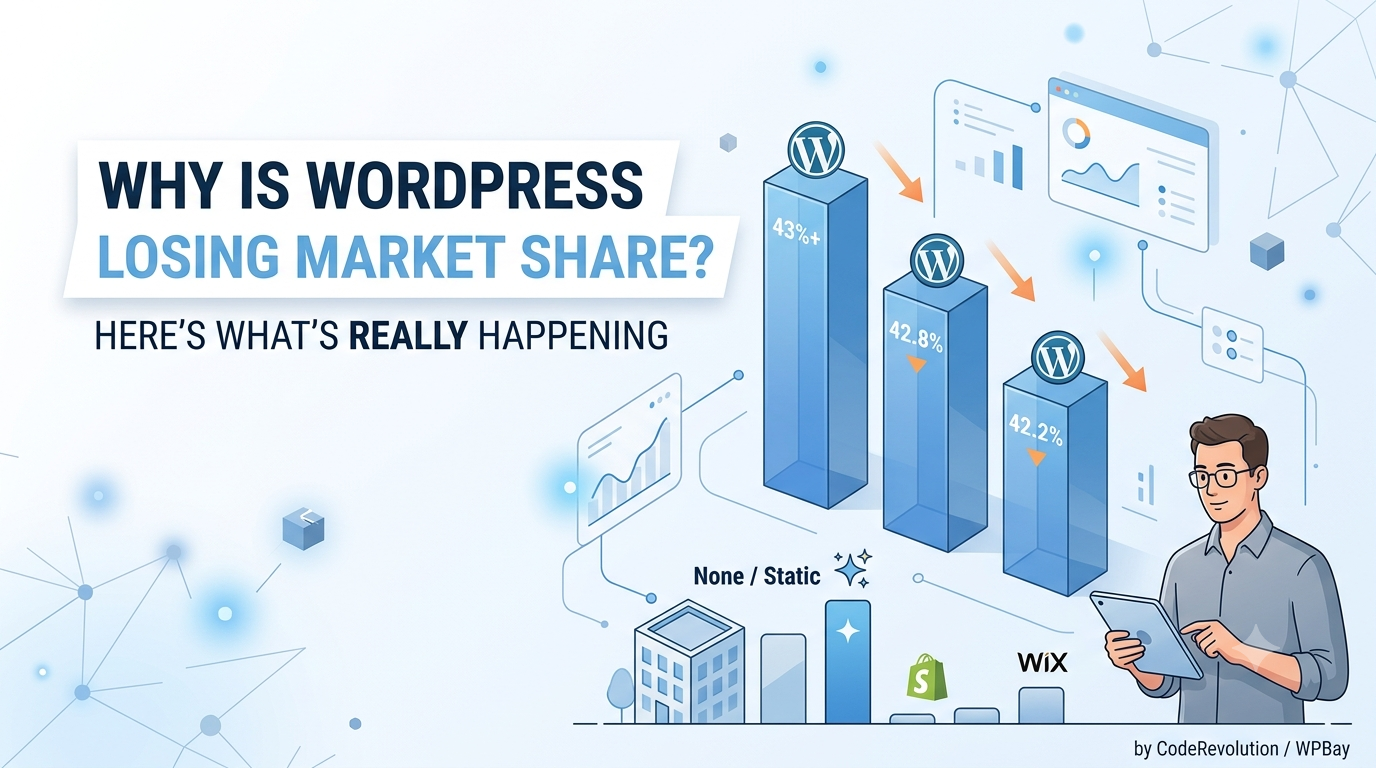
Lately, though, the headlines look completely different. If you look at the data from W3Techs, you will see something that has never happened before. WordPress is actually losing ground month after month, dropping down into the 41% range.
When you run software companies like CodeRevolution and WPBay, you do not just read these stats. You actually feel them. You look at the ecosystem every day to see how people are building sites, what they are buying and where they get stuck. The internet is full of dramatic articles saying WordPress is dying or that platforms like Shopify and Wix have finally won. But the truth is a lot more realistic, as a developer who lives and breathes this code, I can tell you that the sky is not falling. This drop is being caused by a few specific shifts: new technology, developer fatigue, some messy corporate drama and a basic misunderstanding of what a website actually needs to do.
The Actual Numbers: Breaking Down the Recent Slide
To understand what is going on, we need to skip the panic and look at what the data is actually telling us over the last six months.
Dec 2025: 43.2%
Jan 2026: 43.0%
Feb 2026: 42.8%
Mar 2026: 42.7%
Apr 2026: 42.5%
May 2026: 41.9%
This is the first time we have seen WordPress drop for six months straight. The pace is definitely picking up compared to the tiny ups and downs we used to see.
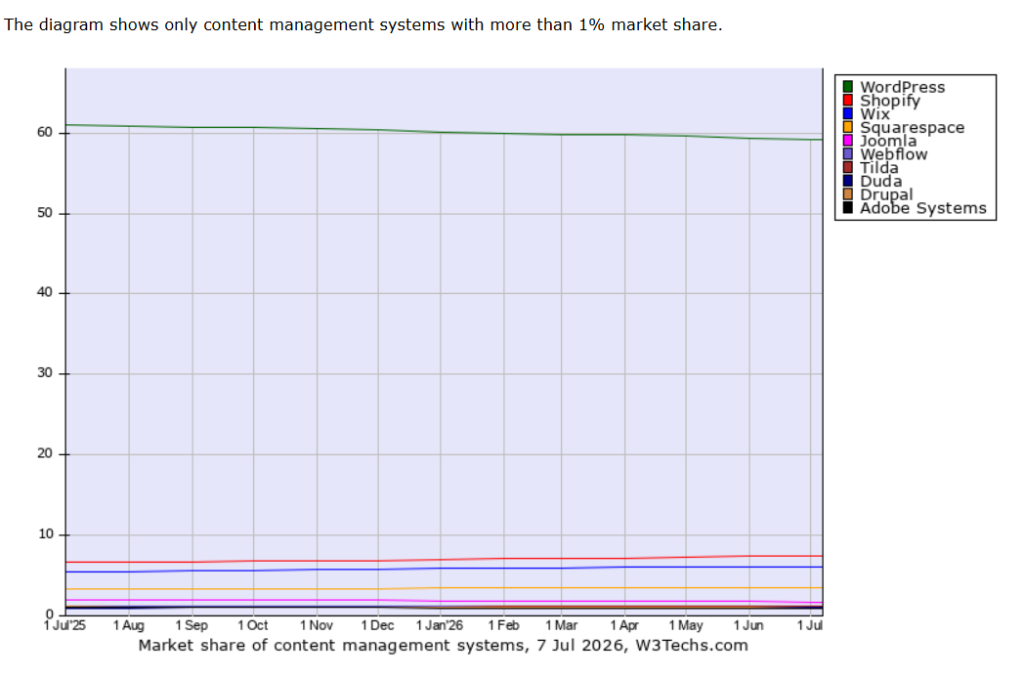
At the same time, proprietary builders are growing, but it is not a massive explosion. Wix is up to around 4.3%, Shopify is at 5.2% and Squarespace is hovering around 2.5%. These numbers show a real shift, but they also prove that the “collapse” narrative is exaggerated. Even at 41.9%, WordPress still powers more of the web than the next ten platforms combined. It is still the giant of the internet.
Check also the CMS market share:
The AI Shift and the Rise of the Engine-Less Web
The easiest explanation people give is that closed platforms like Wix or Shopify are stealing all the WordPress users. While they are growing, they are not the main reason for the drop. A huge part of this shift comes from a category called “None” in the tracking data. These are sites built with no content management system at all.
Why are basic, unmanaged pages growing? Because of generative AI. Now, anyone can describe a layout to an AI tool and get clean HTML and CSS code back in a few seconds. If a local shop just needs a single page to show their opening hours and a map, they do not need to install WordPress, configure a database or buy heavy hosting anymore. They can just generate a raw static page, drop it on a free hosting provider and they are done.
This works great at the start, but it causes problems later when the business grows. A static page has no engine behind it. The moment that business owner wants to add a booking system, a secure contact form or a multi-language toggle, they hit a wall. There is no dashboard, no database and no plugin ecosystem to rely on. They are stuck with a digital flyer instead of a real web application.
WordPress is resilient because it gives you that engine right out of the box. You own the server, you own the data and you can grow from a simple blog to a massive marketplace without throwing away your work. AI-generated pages are taking over the very low end of the market, but they cannot replace a real CMS.
The Corporate Drama and Trust Issues
We also cannot ignore the elephant in the room. The major conflict within the WordPress ecosystem itself has caused a lot of friction. The public legal battles between Automattic and WP Engine have sent a bad signal to the community and the timing lines up perfectly with the faster drop in market share. When people see a hosting provider get blocked from accessing the core plugin repository, it makes them nervous. Suddenly, thousands of sites could not pull updates directly, which exposed risks and worried agency owners and enterprise clients.
This internal fighting has created a bit of a trust crisis. For years, agencies told big clients to use WordPress because it was safe, open-source and not controlled by any single company. Now, decision-makers are looking at the legal drama and wondering if that open-source promise is still a sure thing. The fear of getting caught in the middle of a corporate dispute has caused some high-value users to look at managed alternatives where things feel a bit more predictable.
Market Fatigue and Why Developers Are Shifting
Outside of the big corporate news, there are also real pressures inside the developer community. For a long time, the premium WordPress space relied on marketplace models that are now starting to feel outdated and unsustainable.
The premium plugin and theme industry was built on marketplaces that are changing their core terms. High fees and rigid policies make things tough for independent developers. When the platforms you rely on stop working in your favor, it forces you to rethink how you sell your software. This is exactly why I changed our products to a non-exclusive status on traditional marketplaces, focusing our energy on our own platform at WPBay. To build good software for the long run, developers need a direct relationship with their users, fair subscription models and independence from marketplace rule changes.
When developers feel squeezed, innovation slows down. On top of that, managing a WordPress site has gotten more complex. Between learning the new block editor systems and keeping a stack of plugins secure, some users are just tired of the maintenance. If a business owner feels like keeping their site running takes too much technical work, they start looking somewhere else.
The main challenge for WordPress right now is not a lack of features. It is making sure the platform stays simple for regular users while remaining a healthy, profitable place for the developers who build the actual tools.
What This Means for the Future
A drop from 43% to under 42% is a real trend, but it is definitely not the end of WordPress. It still powers over a third of the web, which is way ahead of any competitor. The platform is adapting to how people build today. Core updates are starting to bring in native AI tools and better infrastructure, showing that the platform wants to make things easier for modern developers without needing clunky workarounds.
If your business runs on WordPress, there is no reason to worry. The main benefits are still exactly the same: you own your data, you have total flexibility and there is a massive global community to help you solve problems.
The market is just growing up. The days of installing WordPress by default for a simple text page are probably over and that is honestly fine. It forces those of us who build themes and plugins to do better work. We have to focus on making lightweight, secure and easy-to-use software that solves real problems. WordPress is losing the users who never really needed a complex database-driven site in the first place. For everyone else who needs real flexibility and control over their business, the open-source web is still the best option out there.