


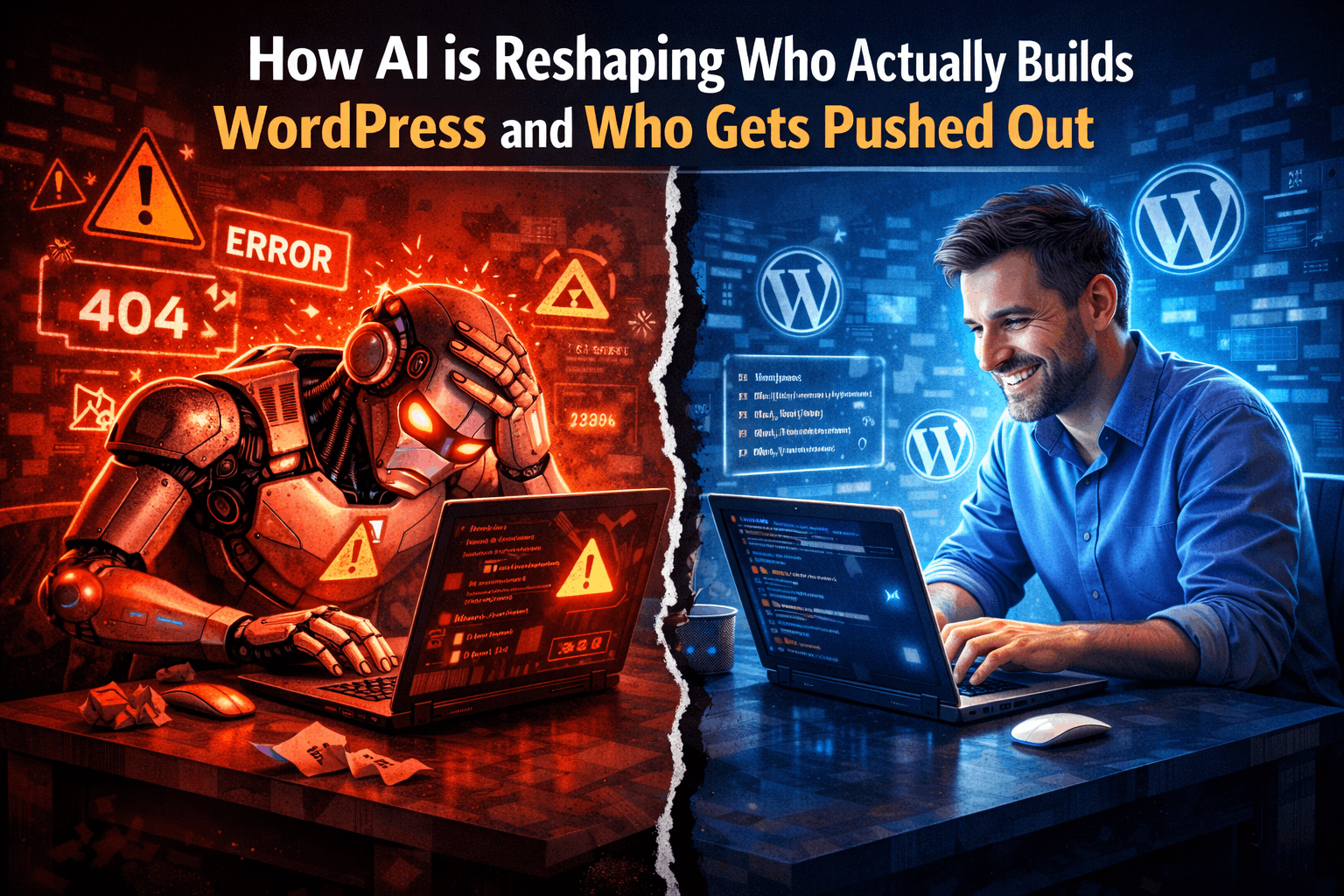
Don’t get me wrong about the point of this post. As the featured image from above already shows, I use AI too. This isn’t about rejecting AI. It’s about what happens when AI lowers the barrier to creating WordPress plugins for people who don’t really understand what they’re building, why they building it or the responsibility that comes with the newly created product.
I remember that at first, AI was just plain helpful. It was like an autocomplete which felt smarter. Things that used to take an afternoon suddenly took ten minutes. Nobody complained, it generated nice feelings in us developers.
But lately, after spending a lot of time reviewing WPBay submissions from different developers from around the world and dealing with the aftermath of bad releases, it’s become obvious that AI isn’t just speeding things up. It’s changing the shape of the ecosystem itself and not in a clean, evenly distributed way, I am sure of this.
I’m Szabi, cofounder of WPBay. I review a lot of submissions of plugins and themes from around here, myself. I test actual plugins and themes, first I check their code base for coding issues, if this passes, I install the plugin or theme and give it a go, check its documentation and try to use its functionality.
What scares me is that over the last months, the amount of AI-generated submissions has exploded… and I don’t mean “the developer used AI to help write part of the code”. I mean entire plugins dumped out of a prompt, zipped and submitted as a product.
ALL of these are REALLY bad. Have tons of settings in their admin menu, 90% of which are not functional. Many features referenced everywhere in the docs, that simply don’t exist in reality. Edge cases ignored completely. Security concerns that would jump out immediately if someone had tested the plugin even once on a real site. If you try to do some exotic stuff during testing, it is easy to even fully break WordPress with a fatal error. Reviewing the AI slop plugins and themes is indeed funny, but also heartbreaking…
We’ve had to issue a lot of hard rejects because of this. Letting this stuff through would be irresponsible from our part. I am sure that users don’t care how a plugin was made. But they TOTALLY care if their site breaks.
This is usually where people say “AI is the problem”. And it’s really not… I also use AI every day. And I am sure most developers also do. AI is incredibly powerful when you already understand what you’re building and also understand its current limitations. It can be really dangerous when you don’t…
There’s a big difference between using AI as a tool and using it as a full time developer. One speeds you up. The other just hides the fact that you don’t really know what’s going on under the hood, if something breaks, your best chance is to feed the entire code base into a different AI model and ask it to fix the problem. However, most of the time, it will not work like this…
I enjoy speaking with software tester friends, who tell me that they have a developer coworker, who built in very sophisticated tool in a single day, only using AI and now they have to test it. Nothing works as expected in the tool, bug reports are filed for each issue, but nobody knows how to fix them, as the AI code is really hard to understand and fix.
The same happens also in WordPress and unfortunately, its users, whether like it or not, are starting to react to that. Reviews are harsher and trust is harder to earn. When anyone can generate something that looks finished, the ecosystem stops rewarding potential and starts rewarding reliability.
I am sure that this process doesn’t hurt experienced developers. If anything, it helps them. People who understand WordPress, who test their work, who know when AI is wrong, I am sure that they move faster than ever now, they build more and more powerful plugins or themes now. The ones getting pushed out are those trying to skip the fundamentals entirely, those who try to build a full product with ZERO involvement from their part.
Nowadays, AI makes it very easy to appear competent. But unfortunately, it is not yet able to make you accountable of your work. Accountability still comes from understanding, testing and fixing stuff which break.
This also changes the role of marketplaces. In my vision, in these “modern days”, distribution matters less when supply is infinite. Filtering is what matters more. Someone has to say “this doesn’t work” even if it looks impressive on paper. Someone has to take the blame for what reaches users and what does not reach them. I feel that this is my role as a reviewer on WPBay. To filter out the slop and allow only true quality work to appear around here. Like this, I hope I do my part to build a better WordPress ecosystem.
In the end, the people who will keep building WordPress aren’t the ones who can generate the most code. They will be the ones who will generate the highest quality code, which works up to customer expectations, or even surpasses them.
